
Grace on the Big Screen

By |2026-06-01T07:58:33-07:00Jun 2, 2026|Articles|

Years back, my wife and I were late to the film, Les Misérables. We got stuck in the second row from the front, gazing straight up at the screen. I am not a film critic, but.... if you don't enjoy musicals, if you are tired of period pieces, if you know nothing about the book, if you have a lousy seat...it was still a film worth seeing. Why? Not for the heart-wrenching scenes (take Kleenex), not for the Oscar-winning performance, not for 19th century French history. See it for the sake of grace. Apart from the Scriptures, I have rarely seen a better portrayal of what grace is and what grace does. Victor Hugo's story is a contrast on the ways of Law and the ways of Grace. Valjean is a man with a guilty past he cannot escape. Javert is the enforcement of law, who hunts Valjean to ensure that strict justice is done. Valjean's life and contribution to society are radically altered by the taste of grace. He becomes an agent of mercy to those around him. Javert’s insistence upon the penalty of law intensifies. He grows so brittle in his pursuit of punishment, he snaps. Valjean, who tasted grace, embraces life, joy and love. Javert, who sees only crime and punishment, is unable to receive the gift of grace offered him. The moral of the story is clear; it is not perfectionism that will make a better world, but the mercy granted to our failures. Mercy from God and one another. The teaching of Scripture is the same. In real life, people don’t converse in song. In real life, people aren't as interesting or funny as a screenwriter script. Outside of theatres, the tragedies of life have no musical score. In our routines, the wheel of coincidence [...]


Beholding Glory: Ezekiel 1

By |2026-05-25T10:20:38-07:00May 26, 2026|Articles|

“Like the appearance of the bow that is in the cloud on the day of rain, so was the appearance of the brightness all around. Such was the appearance of the likeness of the glory of the Lord. And when I saw it, I fell on my face, and I heard the voice of one speaking.” — Ezekiel 1:28 (ESV) Ezekiel was a prophet and priest when the Jews were in Babylonian exile because of their persistent unfaithfulness. Ezekiel’s vision reveals a kaleidoscope of sensational images which are wild and threatening. Wind, fire, and glowing metal. Bronze, coals, and lightning. Gems, wheels, and eyes. The vision presses our faces up to the terrifying, pristine holiness of God. God’s throne is depicted as a chariot pulled by cherubim: living creatures who guard and uphold His perfection. God’s glory cannot be compromised or domesticated. God Himself will depart and punishment will come. Ezekiel falls on his face like many before him because the natural response to seeing God is feeling terrified. A mere glimpse of God’s glory led Moses to tremble (Heb. 12:21), the Israelites to bow face-down (2 Chron. 7:3), and Joshua to drop to his face and knees (Josh. 5:14–15). Saul fell to the ground at heaven’s light (Acts 9:3–4). Whenever we look upon God’s holiness it reveals our own sinfulness at the same time. We fall face down before our holy God in humbled silence. Yet how can we have a relationship with a God who terrifies us? When we see God through an Old Testament lens, it’s impossible. No matter how hard we try, we continue to sin and are left cowering. We become discouraged with our failure and dissatisfied with religious practices that don’t remove our guilt. Because of this, many people view God as an angry warden. The solution lies [...]

Pentecost: Celebrating the Holy Spirit

By |2026-05-19T14:52:27-07:00May 20, 2026|Articles|

Gordon Brownville, in his book “Symbols of the Holy Spirit”, tells about the great Norwegian explorer Roald Amundsen.  He was the first to discover the magnetic meridian of the North Pole, and he was also the first to discover the South Pole. On one of his trips, Amundsen took a homing pigeon with him. When he had finally reached the top of the world, he opened the bird's cage and set it free. Imagine the delight of Amundsen's wife, back in Norway, when she looked up from the doorway of her home and saw the pigeon circling in the sky above. No doubt she exclaimed, “He's alive! My husband is still alive!” Brownville writes, “so it was when Jesus ascended. He was gone, but the disciples clung to his promise to send them the Holy Spirit. What joy, then, when the dovelike Holy Spirit descended at Pentecost. The disciples had with them the continual reminder that Jesus was alive and victorious at the right hand of the Father. This continues to be the Spirit's message today.” That’s a wonderful image and a wonderful truth.  It is also the reason that the early church set aside Pentecost as a reason for celebration.  Yes, it is true that Pentecost marks the beginning of the church.  This is no small or insignificant thing.  But Pentecost tells us there would be no church if it had not been for the coming of the Holy Spirit. In our day and in North American Christian culture, Pentecost as a celebration has been all but forgotten.  And that is not surprising, for I fear that the Holy Spirit has been the forgotten person of the Trinity among many.  I am still amazed at how often I hear Christians referring to the Holy Spirit as “it” rather than [...]

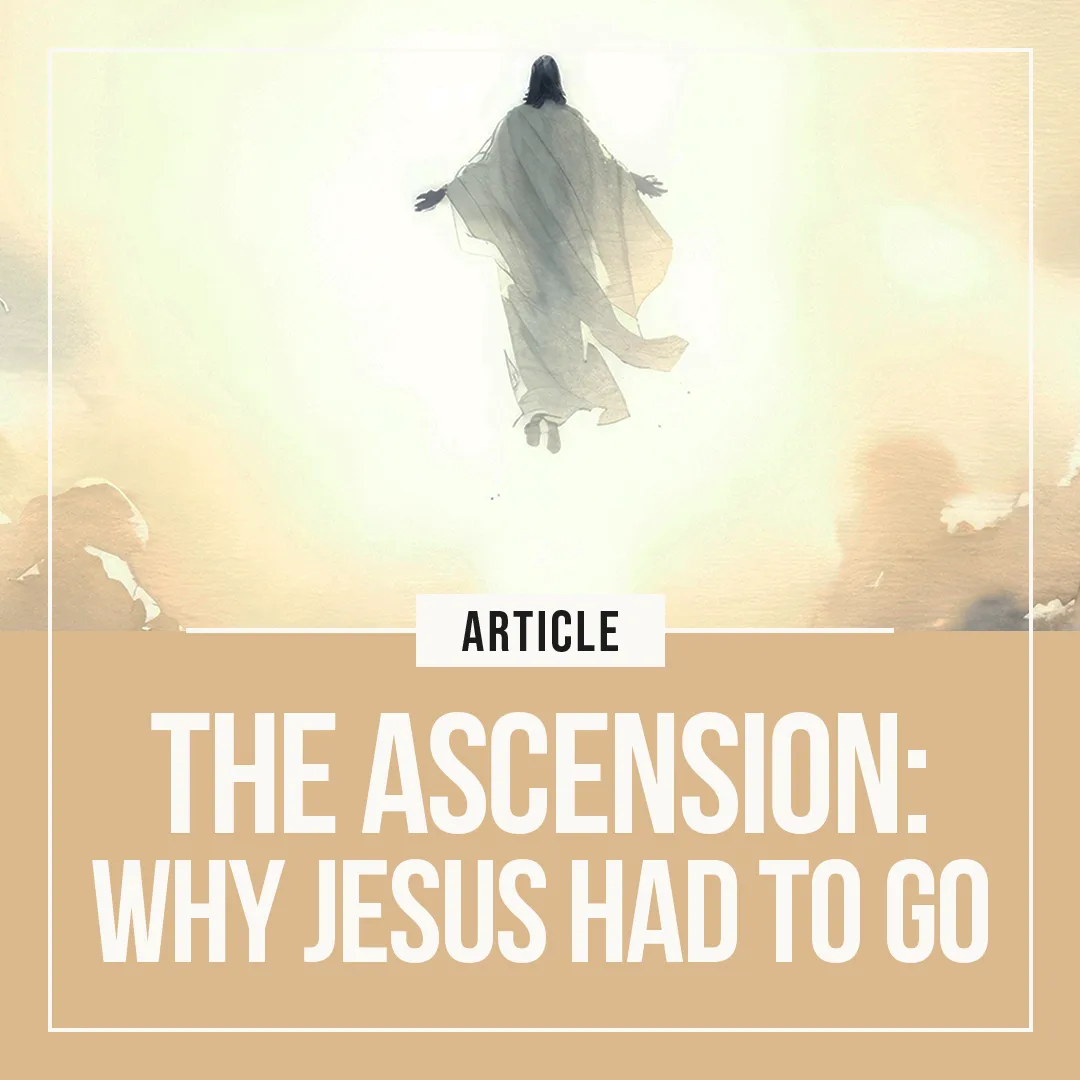
The Ascension: Why Jesus Had to Go

By |2026-05-11T07:49:57-07:00May 12, 2026|Articles|

Imagine that you are in a movie theater watching the Lord of the Rings, and the movie stops immediately after Gollum and the ring disappear into Mount Doom; or if Cinderella cut to credits as soon as her foot fit into the glass slipper. What would be missing? If these stories ended at such climactic moments, we would experience some satisfaction knowing that the conflict had been resolved and that the ‘good’ had triumphed, but we would leave wondering how each story concludes and how people’s (or Hobbit’s!) lives were different as a result. I think the same is true if we end the gospel story of Jesus at the cross. On the cross, Jesus died to pay the penalty for people’s sins and break the power of sin. This event is definitely the climax of the biblical story, resolving the conflict which began in Genesis 3 as sin entered the world. But we must continue past the crucifixion to Jesus’ resurrection and ascension if we want to be faithful to the biblical story, and if we want to understand how people’s lives are different as a result. After Jesus died and was resurrected, Luke records His ascension in this way: So when [the apostles] had come together, they asked him, “Lord, will you at this time restore the kingdom to Israel?” He said to them, “It is not for you to know times or seasons that the Father has fixed by his own authority. But you will receive power when the Holy Spirit has come upon you, and you will be my witnesses in Jerusalem and in all Judea and Samaria, and to the end of the earth.” And when he had said these things, as they were looking on, he was lifted up, and a cloud took him [...]

Faith That Grows

By |2026-05-15T11:14:30-07:00May 5, 2026|Articles|

There are certain conditions that cannot be partial. You are either pregnant or you are not. You are either dead or you are not. There are no half measures to these states. Some think of faith as belonging to the same category. Either you have faith, or you don’t. There is no “in between”. They consider faith as absolute confidence with no shades of doubt. They assume that any amount of ambiguity corrupts the whole faith. Faith must be 100% whole, or it doesn’t count as faith. This approach to the question of faith may need to be fine-tuned. At times, my faith falls in the middle ground of trust, depending on the situation and season of my life. I sympathize with the father who appealed to Jesus for his child, “If you can do anything, have compassion on us and help us!” When Jesus challenged the word “if,” the father blurted out, “I believe; help my unbelief!” (Mk.9:22-24, ESV). Jesus healed the child. He accepted the father’s quasi confidence. Our Lord responded to the faith that was, even if absolute trust was a level too far at this point. The presence of faith may begin with the size of a mustard seed, but it is meant to grow. When we first put faith on, it may look like a baggy outfit we cannot fill. Faith allows room for us to expand. The first step of any disciple is to grasp the seed of faith and then begin the ministry of the Spirit to enlarge it towards maturity. Faith doesn’t come fully formed. Faith is learned, and it grows. We learn it in our finances, with our health and our future. We are taught faith when children arrive and when they leave. Our trust is stretched by the known, which [...]

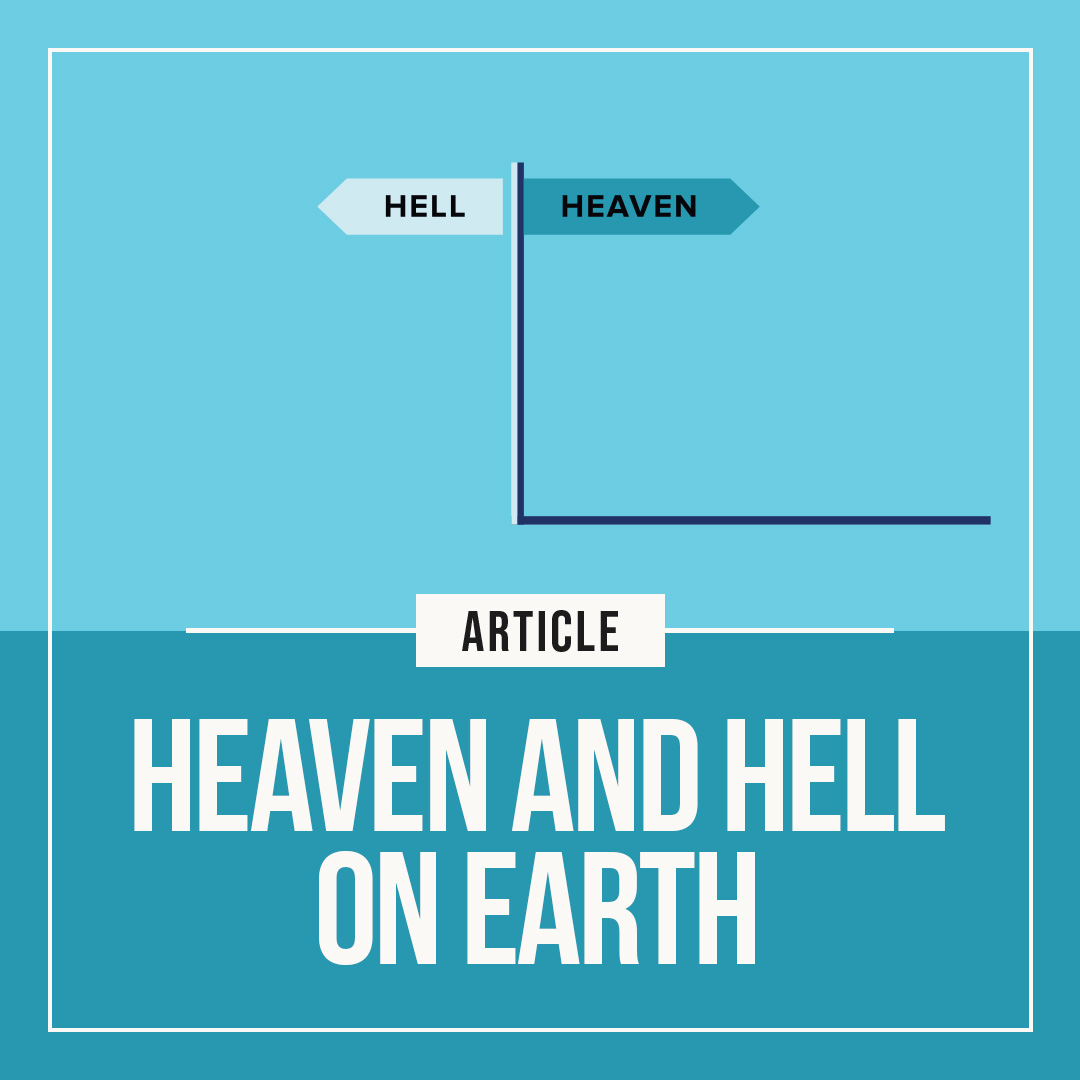
Heaven and Hell on Earth

By |2026-04-27T12:50:43-07:00Apr 28, 2026|Articles|

God has, for His wise purposes, allowed a foretaste of both heaven and hell to be felt upon this earth and in our present experiences. No, it is not a literal heaven and a literal hell (those are real places that will be far more extreme), but a foretaste of it. But why? If we only had foretastes of heaven and not of hell, we would not worry that the day of eternal accounting was before us; we would not consider our rebellion against God — our ignoring of Him who is altogether worthy of all honour. But if there were only foretastes of hell here on earth, we would think that there is no hope for us at all. We would think only judgement and wrath await. But how about that balance of the two, between those foretastes of heaven and hell? Is it, we might ask, a proper balance? For many, when they ask why there is so much evil and suffering in the world, they ask how there can be a loving God if He allows such things to occur. For many of us, the question is, “why so much of a foretaste of hell?” It is, we think, too much. On the other hand, some of us don’t ask why there is so much good! Given our rebellion against God, given that the entire human race has sinned, has declared war against the Creator upon whom we are dependent at each moment — given what we have done, how is it that there is so much good? If you are suffering right now, might I commend Psalm 104 to you? “You make springs gush forth in the valleys; they flow between the hills; they give drink to every beast of the field; the wild donkeys quench [...]

Pursuing Joy in the Lord

By |2026-04-21T05:29:13-07:00Apr 21, 2026|Articles|

If you run the Christian race long enough, you or someone you care for will inevitably come to a point in the marathon where you are out of breath, your legs are on fire, and the next rest stop is nowhere in sight. Whether it be sickness, sorrow, loss, or loneliness, spiritual hurdles seem to come into our path at the most unexpected and unwelcome times. In those moments, it is common to be offered encouragements from well-meaning people that can fall flat. One of the most common phrases that I have heard time and time again across my years in the faith is: “remember to have joy in the Lord.” While I believe there is an incredible theological truth within that statement, it is too often reduced to a platitude. So, the question is: what is this joy and how is it experienced? What is often missed is actually inherent to the phrase that joy has a trajectory, a direction. The encouragement is not to simply have joy but that it is found in the Lord, not in what He gives, or the circumstances He ordains, but in God Himself. Our joy ought to lead us into, and flow out of, the worship of our Creator. Because this joy is not dependent on circumstance, it holds steady in both the highs and the lows of life. It is this kind of joy that enables us to embody the truth Paul writes—that whether “in plenty or in want,” our fulfillment is found in Christ alone. We can celebrate and praise, we can weep and still wonder at His goodness. To those who are suffering, do not strive to force joy, but look to Christ, in whom it is found. And to those who would comfort, do not rush to speak, [...]

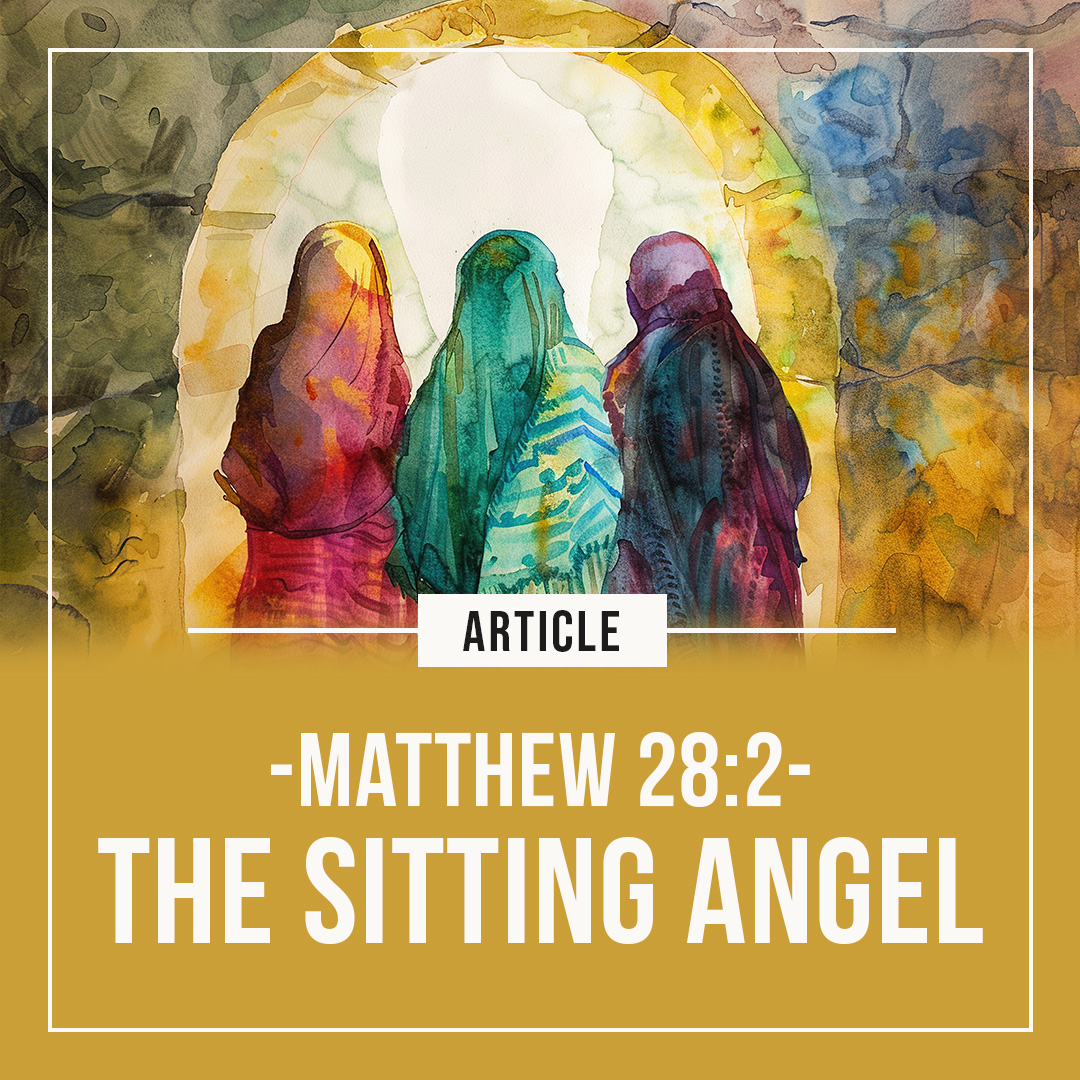
Matthew 28:2 – The Sitting Angel

By |2026-04-14T11:38:18-07:00Apr 14, 2026|Articles|

“And behold, there was a great earthquake, for an angel of the Lord descended from heaven and came and rolled back the stone and sat on it.” Matthew 28:2, ESV Surprising Posture The Easter story is nearly 2000 years old. For centuries, it’s been read, heard, sung, dramatized, discussed, preached, explained and squeezed for every drop of truth it holds. And yet, it hasn’t been emptied, nor can it be exhausted. There is always something to learn, a detail that lingers, like an undiscovered Easter egg waiting to be found. I was surprised this Easter by a small fact that might be inconsequential - or maybe not. When Mary Magdalene, Mary the mother of James and Salome, Joanna and other faithful women went to the tomb early Sunday morning, they discussed on the way how they would move the stone blocking the tomb. It was a problem they would not have to solve. They found the grave open, the Roman guards unconscious, and an angel of the Lord, as brilliant as lightning, sitting on the stone.  Perhaps like you, I find the angelic posture surprising. If there was a choir of angels around the tomb entrance singing the “Hallelujah Chorus,” I would not be surprised. If there was a legion of the heavenly host with swords drawn, proclaiming victory, I could envision that. But an angel sitting on the stone, as casual as a park bench, seems too subdued, if not odd. Does the angel’s demeanor mean anything? It could be argued that the angel’s posture was intended to be inviting, less frightening for the women. But the angel’s pose didn’t eliminate the women’s shock and fear. While the angel reassured them, “Don’t be afraid!” -  alarm would be a normal response considering the situation. Perhaps the posture suggests more [...]

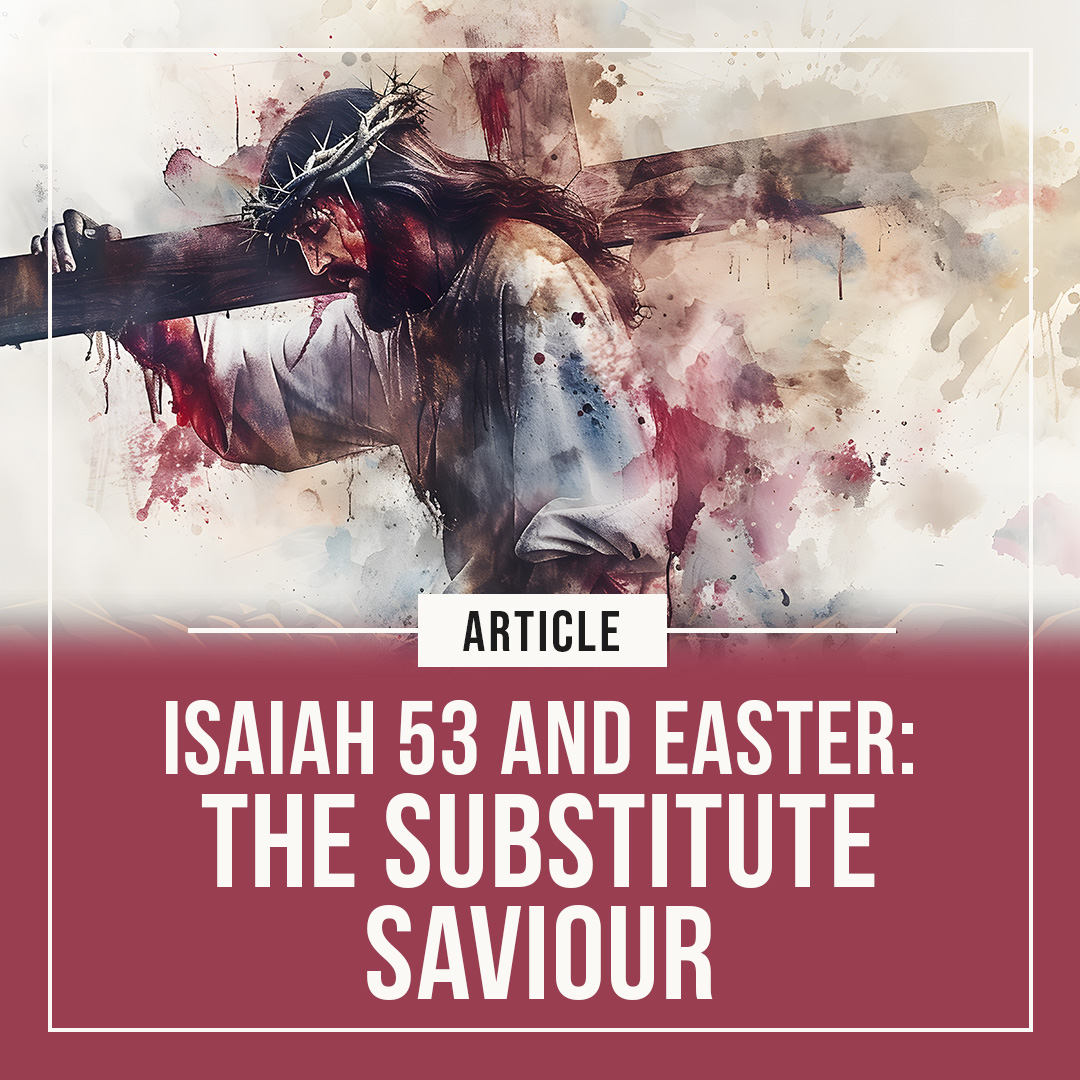
Isaiah 53 and Easter: The Substitute Saviour

By |2026-04-02T15:09:27-07:00Apr 2, 2026|Articles|

Hour after dreaded hour went on, and Jesus continued to hang on the cross, suffering in a way no human being can imagine.  The horrors of crucifixion have been well documented by others.  The Romans had developed a method of capital punishment not dreamed of by others.  And so, Jesus suffered intense physical pain.  Furthermore, men gathered around Him and mocked Him.  The Son of God mocked by wicked men.  But there was more.  Indeed, His greatest suffering was neither the physical pain nor the psychological mocking from His enemies. Isaiah, over 700 years before the crucifixion of the Messiah, helped us understand what this event would entail.  In chapter 53:4 (ESV), He was “smitten by God,” says Isaiah.  In verse 6 of the same chapter, Isaiah says “the LORD has laid on him the iniquity of us all.” Read with great care the words of Isaiah 53:10 and tremble.  “Yet it was the will of the LORD to crush him.”  It’s hard to take these words in.  But we must face what the prophet tells us.  “It was the will of the one true living God to crush His eternal and beloved son on the cross.”  God had willed it.  He was crushing His Son on the cross. And as hour after horrifying hour dragged on with Jesus, our sin substitute, hanging on the cross, suffering for the sins of the world, He cried out, “How long?  Why have you forsaken me?” And yet while we might well recoil from such horror, one salient truth must not be forgotten.  While He hung bleeding, dying and being crushed by the Father, Jesus never ceased to be the object of the Father’s delight.  Isaiah said of Jesus “the will of the LORD shall prosper in his hand.” Here hung the Son, [...]
Palm Sunday: An Unexpected King

By |2026-03-26T14:13:58-07:00Mar 27, 2026|Articles|

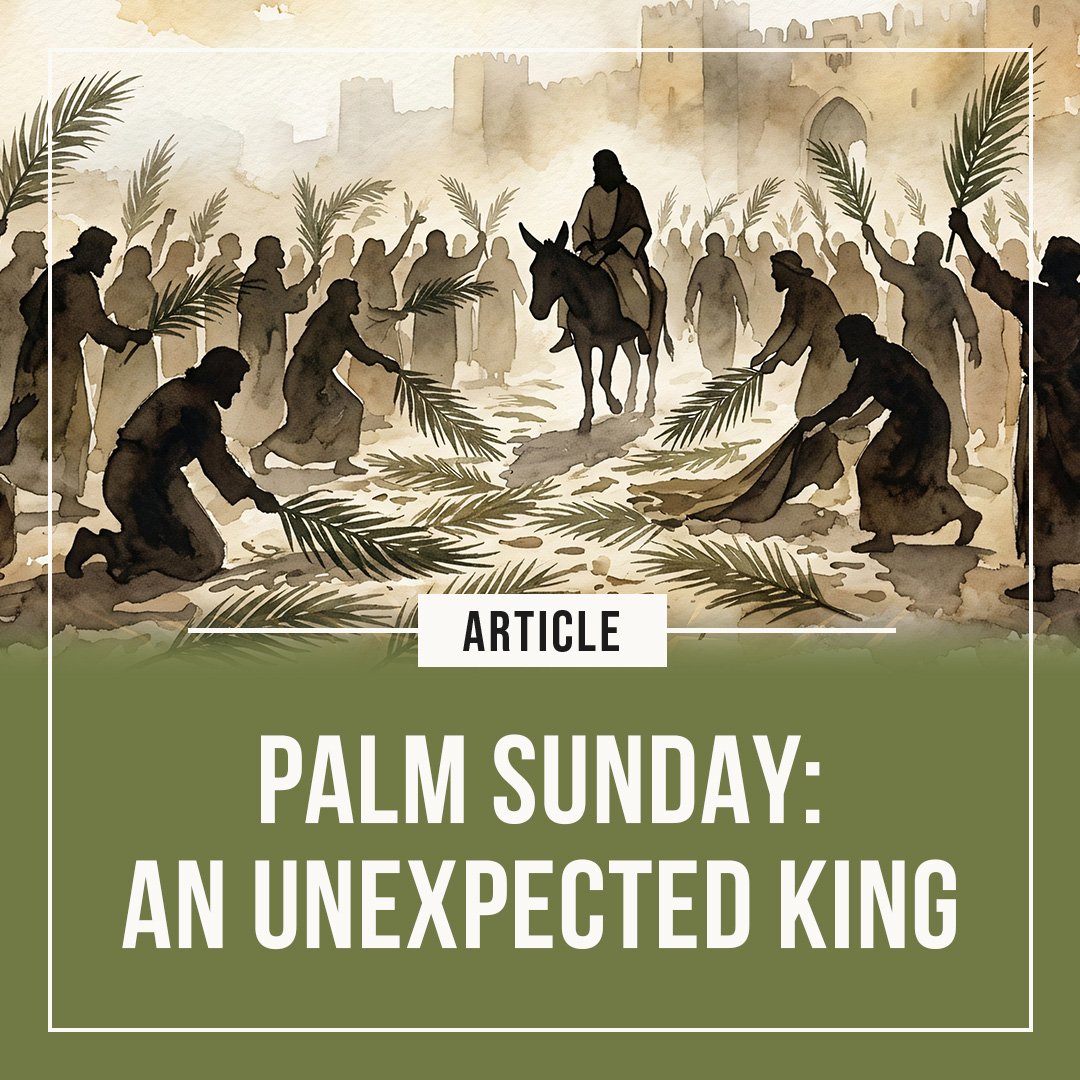
Palm Sunday is a day of amazing contrasts. While we often approach God with what we want from Him, God is determined to instead give us what we desperately need for His glory and our eternal wellbeing. As Jesus rode into Jerusalem that Sunday, we see the expectations of Israel contrasting with what Jesus actually gave them five days later. “The next day the large crowd that had come to the feast heard that Jesus was coming to Jerusalem. So they took branches of palm trees and went out to meet him, crying out, ‘Hosanna! Blessed is he who comes in the name of the Lord, even the King of Israel!’” — John 12:12–13, ESV This is happening during Passover, the celebration of God delivering Israel from slavery in Egypt. For almost 600 years the Jews had been enslaved by one nation after another, but at Passover they would long for God to send the Messiah, King David’s Son, to deliver them from their current oppressors.  Every year, when Passover was finished and the Messiah had not come, they would say, “Next year in Jerusalem…” — perhaps then he will come! Now here was Jesus, and just like the prophets predicted, He fed the multitude and healed the sick, blind, lame, lepers, preached good news to the poor, and had even raised Lazarus from the dead!  It finally seemed like this was the year. “This year in Jerusalem!”  So as the word came that He was coming, thousands lined the road to usher Him in. They were hailing Jesus as their King.  They didn’t care that Rome could view this as treason, they were offering Jesus the ancient throne of David to rule them as King. But remember, these hopes were given to them by God! This crowd wanted a [...]

The Just Redeemer

By |2026-03-20T14:41:13-07:00Mar 20, 2026|Articles|

As I write this article, I am on vacation in San Francisco. If you’re familiar with the Bay Area, you’ll know that Alcatraz Island is an iconic site, notorious for serving as a federal maximum-security penitentiary from 1934 to 1963, with famous prisoners like Al Capone and Robert Stroud (a.k.a. the Birdman). During the tour of Alcatraz, I couldn’t help but imagine what it would be like to be incarcerated in such a prison for years. The dark, damp cells gave me the chills. As gruesome as prison life could be, societies accept that such an institution is necessary for justice and accountability for those who commit serious crimes. Our desire for justice is not surprising. The Bible asserts that there must be consequences for sin. We are going through the Book of Ezekiel at our church, so we have had ample opportunity to address the perils of sin and why God must move against it with all his might. However, as much as putting criminals behind bars may deter people and protect the community, our justice system is far from perfect because we cannot offer restoration. I have a friend who received the heartbreaking news that his son had been murdered. Although the murderer was caught and put behind bars (our justice system at work), my friend did not receive his son back. There was no restoration, no reconciliation, no redemption. Although the imprisonment of the murderer was important for accountability, it could not undo the terrible loss for this family. I had the opportunity to ask a Supreme Court judge about this shortfall of our justice system, and the judge agreed that our system cannot fully bring justice to situations like this because we do not have the ability to make things whole again. God says that his [...]

Does God’s Patience Run Out?

By |2026-04-17T09:25:02-07:00Mar 13, 2026|Articles|

Many moderns have never considered the idea that there comes a time when God’s patience is exhausted. Perhaps this thought has never occurred to you.  It may be because when we hear of the mercy of God, His kindness, His forgiveness, His grace, we assume that these are God’s attributes at the expense of all others.  But God is righteous and demands that His righteous requirements are kept.  For this reason, the book of Nahum may shock you. So why read and study this small minor prophet from the Old Testament? Because it is part 2 of the story we find in Jonah.  So many of us love Jonah because it announces that even the most wicked among us can find the mercy and kindness of God. Jonah wanted God to condemn Nineveh and Assyria, but instead, He looked for a way to extend mercy to people who don’t deserve it.  That is the gospel!  God has found a way, in Jesus, to extend mercy to those who don’t deserve it. Rather than us receiving the wrath of God, it fell onto His Son, and we are the objects of His love and grace. That’s the wonder of the gospel. But Nahum is part 2.  What happens if we presume on this grace?  In the New Testament book that most clearly shows us the heart of the Gospel, we find these words:  “Or do you presume on the riches of his kindness and forbearance and patience, not knowing that God’s kindness is meant to lead you to repentance? But because of your hard and impenitent heart you are storing up wrath for yourself on the day of wrath when God’s righteous judgment will be revealed.” (Romans 2:4–5, ESV) How do we “presume on the riches of his kindness and forbearance and [...]

Is Prayer Precarious?

By |2026-03-10T11:46:51-07:00Mar 10, 2026|Articles|

One picture is worth a thousand words. But one word is worth a thousand pictures as well. Let me draw some pictures and you discern the word. You are riding on a bus through the Andes. The road is as wide as a fat donkey, but little more! The driver speeds like a NASCAR driver, and the drop to your right is a doorway to eternity. How do you feel? Another: you've worked hard on a project, but your customer is famous for their fickle response. They could smile or fire you just as easily. It's some of your best work, but after you've hit the send button, what's in your chest? One more: your oldest is getting married. It's the first family wedding and nothing within your resources has been spared. It sounded like a great idea to have an outdoor ceremony at the beach, but as the day moves forward, the forecast is foreboding. Everything is set. There's no turning back. On the morning of, you view dark hail clouds on the horizon. You feel like your situation is ….what? So, what's the word? Which adjective matches what you feel or think in those situations? If you haven’t gotten the hint from the title, the word is “precarious.” The dictionary blends the pictures I've scripted under one word and defines it as, "dependent on something or someone outside of our control." If that is where you are, then your situation is precarious. It need not be a dangerous situation. The circumstances could help you as much as they could hurt you. But what makes our context precarious is that we are not in control. We are dependents. So, we feel insecure, unstable, afraid. We don't like being dependent. We prefer to control, to predict, to live with certainty. [...]

When God Feels Silent

By |2026-03-03T01:34:10-08:00Mar 3, 2026|Articles|

If you walk with Christ long enough, you'll eventually hit a season where heaven seems achingly quiet. You open the Scriptures, and they feel flat. You pray, and it feels like your words barely clear the ceiling. You look for guidance, for comfort, for something, and all you find is stillness. I know that terrain well. When my wife died, a great silence seemed to swallow the world. People spoke words of comfort, and I was grateful for every one of them, but the silence underneath it all was deafening. I would sit with my Bible open on my lap, whispering prayers through tears, and nothing seemed to come back. No warm feeling. No sense of nearness. No dramatic intervention. Just that still, heavy quiet. And in that quiet, a truth surfaced that I wish we talked about more openly: God's silence is not God's absence. The psalmist understood this ache. "O LORD, how long will you forget me? Forever? How long will you look the other way?" (Psalm 13:1, NLT). That's not a man with a tidy devotional life. That's a man who feels abandoned. And yet, by the end of that same psalm, he says, "But I trust in your unfailing love." Trust in a silent season is not naïve. It's faith doing its deepest work. So what do we do when God feels silent? Let me offer a few steps — not theories, but footholds I clung to when the ground beneath me shifted.   Keep showing up, especially when you don't feel like it. In the months after losing my wife, I didn't feel like reading the Bible. I didn't feel like praying. Grief has a way of hollowing you out. But I learned something I haven't forgotten: obedience often precedes emotion. Isaiah says, "Those who [...]

God’s Purpose in Prison

By |2026-03-01T10:58:56-08:00Feb 23, 2026|Articles|

Our greatest inconveniences, our greatest disappointments, even the injustices done against us are so designed by God so that we might be fruitful in His work. And so it was with Paul. I’m beginning a series on the final chapters of Acts — wonderful chapters. Chapters 25–28 are filled with adventures, everything from court cases to a shipwreck to a snake bite to arrival in the city of Rome in chains. Great drama filled with swashbuckling adventure. But let’s get some of the context that led to the drama at the end of this book. Paul, after his amazing adventures bringing the gospel to one gentile city after another, is now making his way to Jerusalem to support the hard-pressed Christian community there. When Paul arrives, he is met by Christians very concerned for him.  They know the city was a powder keg now that he had arrived. And then, of course, a riot ensues.  Without foundation, Paul is accused of bringing a Gentile into the temple.  The Romans intervene, and Paul is held in prison. Eventually Paul was charged and his case heard.  Though he knew Paul was innocent, the Roman governor Felix kept him in prison to appease the Jewish leaders. Eventually Felix gets removed — replaced by Porcius Festus — but Paul remains in prison for two years, unresolved. That brings us to Acts 25, where Porcius Festus now begins to deal with Paul, which means more trials — but great adventure ensues! By now Paul could have already been in Spain bringing the gospel to a part of the world that had never heard it before.  And after that, who knows?  The sky was the limit!  Yet here he was, rotting away in prison. But here we see the providence of God.  By the end of [...]

Love vs. Truth

By |2026-02-15T02:45:43-08:00Feb 17, 2026|Articles|

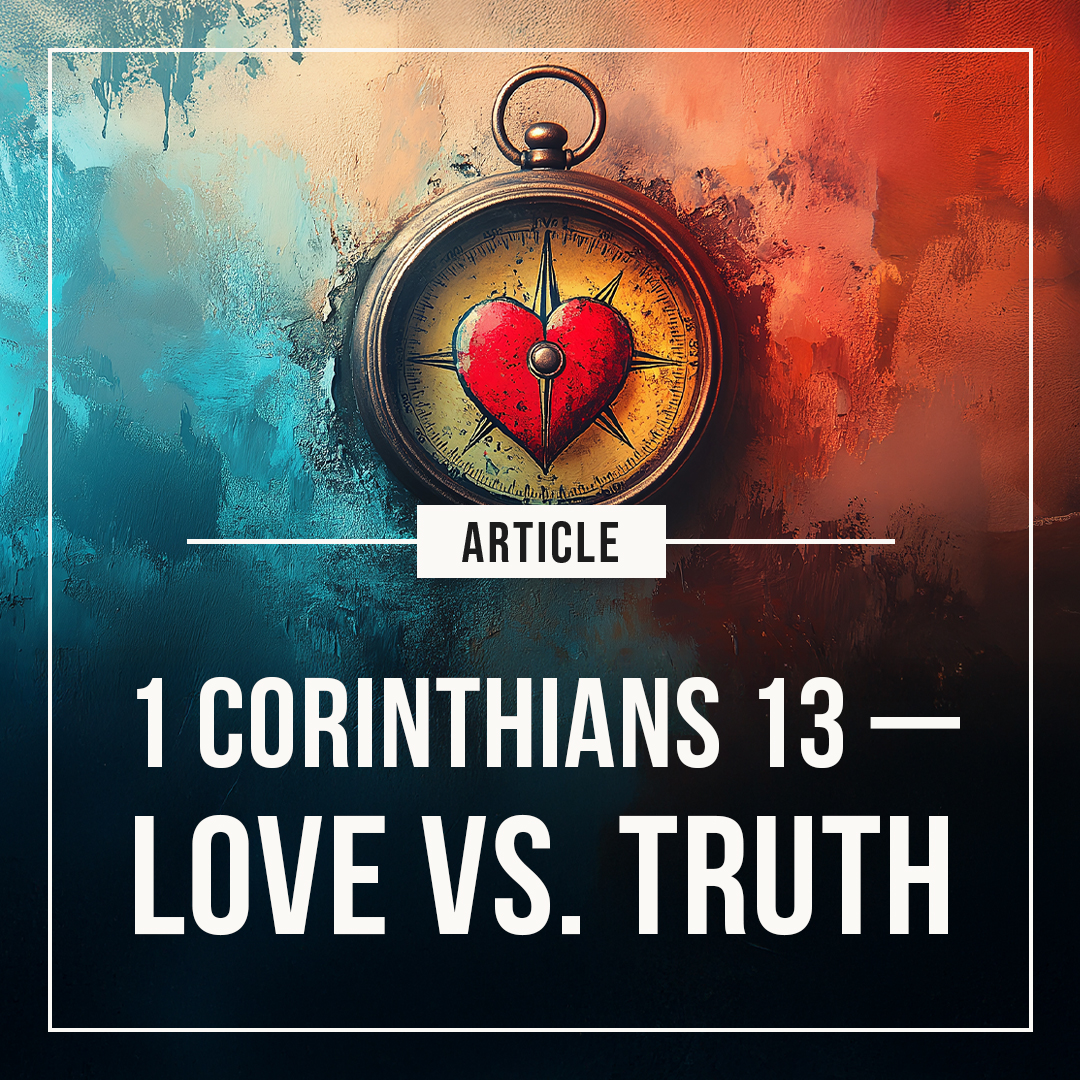
Many would say that the greatest Christian virtue is love—and they’d be right. Paul affirms this in 1 Corinthians 13:13 (ESV): “So now faith, hope, and love abide, these three; but the greatest of these is love.” Quite often, 1 Corinthians 13 is viewed as this flowery and feel-good piece of literature that Paul sandwiches in the middle of two frameworks for spiritual gift operation. But is this really the case? I recently came across an article from Bill Mounce (a New Testament scholar and Founder/President of BiblicalTraining.com), in which he argues that this chapter is more of an indictment against a church that was spiritually gifted yet completely off the rails. In this article, he states, “I can hear Paul punctuate his words… You think you are so important, but all the gifts you treasure will one day be gone, and you will be left with nothing because you have neither faith, hope, nor love.” So 1 Corinthians 13 isn’t feel-good, it’s a rebuke to a church rich in gifts but poor in love. This highlighted something significant to me. We can become so focused on one aspect of God’s character—the very character we’re called to reflect as followers of Christ—that we fail to see the danger of imbalance. The church of Corinth was so focused on excelling in spiritual giftings that they were completely blind to the fact that love was not at the centre of it all. If Paul wrote to today’s Western church, what imbalance would he address? If you were to ask me, at the top of that list would be a calling out of the exultation of compassion above truth. We’ve become so blinded by cultural pressure to affirm everyone’s individuality that we’ve sacrificed truth on the altar of approval. And look, I get [...]

Advocating for Sola Scriptura

By |2026-02-06T14:56:24-08:00Feb 6, 2026|Articles|

I love the word, “irenic”.  It comes from a Greek root word irene, which means peace.  To be irenic is to be peaceful.  But that doesn’t mean one has no opinions or that one does not ever take issue with others.  Those who agree with everyone really can’t be described as irenic; I would use other words: gullible, uninformed, easily manipulated, easily swayed, easily impressed, never taking a stand.  They go along to get along.                   But let’s say you do have ground upon which to stand and let’s say you think some truths need to be vigorously defended.  What are your options then?  Well, one option is that you would be combative, strident, in-your-face, easily offended, prickly, ready to break relationships whenever things don’t go your way.  We have all met people like that. The Wisdom From Above                   For this reason, I love James 3:17. It says, “But the wisdom from above is first pure, then peaceable, gentle, open to reason, full of mercy and good fruits, impartial and sincere” (ESV).  Did you notice those words? “Pure”, which means that there are no secondary hidden motives behind the wisdom from above — no agendas that are concealed until the person gets what they want. And then the next word: “peaceable”.  It is not looking to harm the other or to cause them either pain or for them to lose face.  It actually cares about the wellbeing of the person with whom one disagrees. And then “gentle”.  No shouting.  No in-your-face, violent outbursts. Next, wisdom from above is “open to reason”.  It is willing to reason with the other.  It invites the opponent to set forth their case, and if it is sincerely done, to consider the merits of the argument that is given. What Is Sola Scriptura?                   [...]

Should I Really Fear God?

By |2026-02-03T02:45:32-08:00Feb 3, 2026|Articles|

On more than one occasion, I have found myself trying to explain an apparent conundrum in the Bible.  On the one hand, we are commanded to fear God.  Psalm 2:11 (ESV) seems very straightforward: “Serve the Lord with fear, and rejoice with trembling.” Indeed, Proverbs 9 tells us this is not only commanded; it is wise: “The fear of the Lord is the beginning of wisdom, and the knowledge of the Holy One is insight.” — Proverbs 9:10 These are the kinds of verses we teach in Sunday School, as well as the kind of things we teach new converts.  But we also know the very famous 1 John 4:18, “ There is no fear in love, but perfect love casts out fear. For fear has to do with punishment, and whoever fears has not been perfected in love.” Well, which one is it?  Are we to fear, or are we not?  The normal answer that is given is that the fear of God is equivalent to reverence for God. It’s just another way of saying revere God or give Him the respect He is due.  Yeah, that’s true as far as it goes.  But please hear the recorded words of Jesus. “I tell you, my friends, do not fear those who kill the body, and after that have nothing more that they can do. But I will warn you whom to fear: fear him who, after he has killed, has authority to cast into hell. Yes, I tell you, fear him!” — Luke 12:4–5 The reason you fear God is because He has the power to throw you into hell!  So that, as we can clearly see, is more than reverence and respect.  It is the terror of what the ultimate Ruler of all things can do should we [...]

The Gift of Being Interruptible

By |2026-01-27T12:31:21-08:00Jan 27, 2026|Articles|

My wife and I just returned from a holiday that was, apparently, “unique” for me. Glenda insists it was. We set off without every detail locked in—some nights we hadn’t a clue where we’d land. And I discovered, rather quickly, just how fond I am of having every bolt tightened and every plan neatly in place. Most leaders like a good plan. We map out our days, guard our calendars, and take quiet pride when we manage to tick every item off the list. But if you’ve walked with Jesus for any length of time, you know He has a way of stepping into our tidy plans and redirecting our path. The truth is some of God’s greatest Kingdom moments come disguised as interruptions. When Luke tells the story of Jesus on His way to heal Jairus’s daughter (Mark 5:21–43), he’s not describing a leisurely stroll. We have a desperate father begging Jesus to hurry. Time is precious. The crowd is pressing from every side. And in the middle of this urgent mission, a woman who has suffered for twelve years reaches out and touches His robe. In our modern way of thinking, this is the moment a leader would say, “Not now. I’m busy.” But Jesus stops. He turns. He listens. He engages. He sees her, and in their exchange, her identity is transformed from a suffering, unclean street person to “Daughter.” It’s a powerful reminder that the Son of God, on a life-and-death assignment, was interruptible. What His followers saw as a distraction, Jesus saw as the ministry itself. He understood that His Father’s plan was not just about the destination, but about the people He met along the way. Being interruptible doesn’t mean being disorganized or sloppy with our responsibilities. It means living with a heart that [...]

The Mercy of Restoration

By |2026-01-26T13:18:01-08:00Jan 20, 2026|Articles|

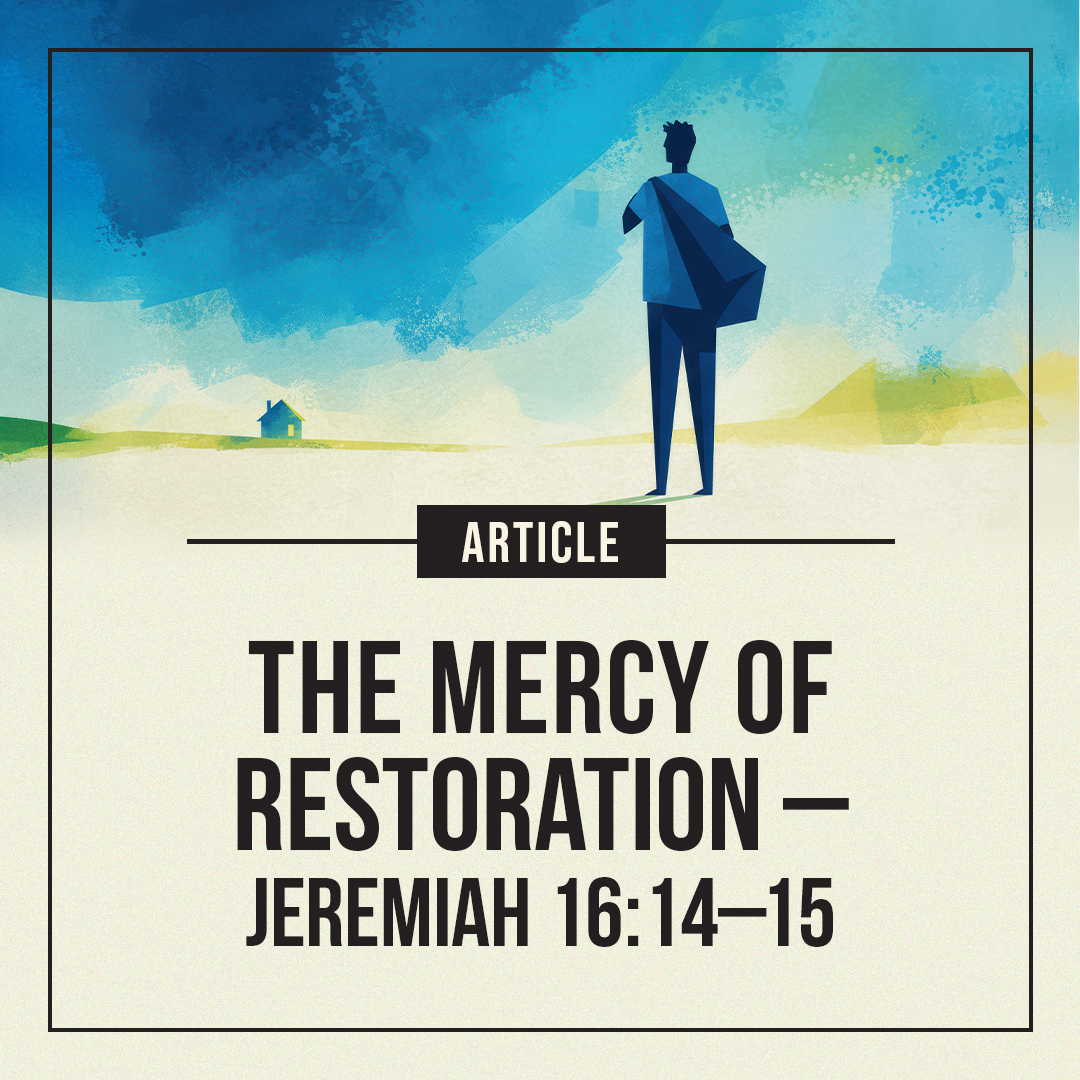
Therefore, behold, the days are coming, declares the Lord, when it shall no longer be said, ‘As the Lord lives who brought up the people of Israel out of the land of Egypt,’ but ‘As the Lord lives who brought up the people of Israel out of the north country and out of all the countries where he had driven them.’ For I will bring them back to their own land that I gave to their fathers.” Jeremiah 16:14-15, ESV   This week as I read my Bible, sparks flew off the page. It happens once in a while. This time the ignition point was Jeremiah 16:14-15. You can turn there yourself, but have a fire extinguisher handy. Here's the context. God is about to bring judgement upon Judah - severe, unrelenting, devastating judgement. God will employ the Babylonians to tear down His own city, demolish His temple and march His people as captives into a foreign land. The causes of such extreme measures are scattered throughout Jeremiah's book; but hope is also planted by the prophetic voice. God's judgment is not void of mercy. The Lord promises that He will bring His people back home. There is a dawn to this darkness. That's where the sparks flew. Israel used to boast of how God brought them out of the land of Egypt. The 10 plagues, Red Sea miracle, Sinai covenant - these were emblems of His great redemptive grace. But Jeremiah says Israel will change their boast. Instead of pointing to the exodus as the epitome of grace, they will speak of their return home from Babylon. The proof of His love is this: "God brought us back." In other words, the mercy of restoration speaks louder than the mercy of redemption. So, you can understand the singe marks [...]

Where’s the Fun?

By |2026-01-06T01:40:49-08:00Jan 6, 2026|Articles|

My sons recently found an old box of Monopoly in the basement. They brought it upstairs and placed it on the kitchen table. Wiping away a thick layer of dust, my 7-year-old asked, “what’s Mono-polly?” It was the same box I grew up with, I forgot it was even down there. “It’s a game,” I said. They lifted the top like little archaeologists, delicately opening some long-buried treasure. “Woah…” was their shared pronouncement. That night we played Monopoly past their bedtime (okay, my wife says “way” past bedtime). When we finally finished and the kids were all tucked in, I turned to my wife and said, “that was fun.” And I didn’t even win. Some of the best memories we create as kids are simple times of fun. Pure, effortless fun. Board games with family, playing in the backyard, visiting friends. How strange then that we do not often prioritize fun as a family. In all the to-do’s and busyness of the week, it’s easy to overlook or diminish the importance of simply “having fun” together. Yes, we may allow our kids the indulgence of fun – but fun as a whole family? Fun for the parents? “We’ll see… If there’s time… After work… Maybe on the weekend.” Fun is pushed off, relegated to the leftovers of our tightly packed schedules. Is this healthy behaviour? According to the National Library of Medicine, enjoyable leisure activities are attributable to better health both psychologically and physically, including “lower blood pressure, total cortisol, waist circumference, and body mass index, and perceptions of better physical function.”[1] Or, as Proverbs 17:22 (NIV) states: “a cheerful heart is good medicine.” Fun builds relationships and strengthens social bonds. Fun reduces stress and improves mood. Fun provides rest. Fun is healthy! So why don’t we prioritize fun? Have [...]

Wisdom for a New Year

By |2026-01-10T04:02:03-08:00Dec 30, 2025|Articles|

“For everything there is a season, and a time for every matter under heaven.” - Ecclesiastes 3:1, ESV   What Time Is It? Learning to tell time is a life skill, often mastered between the ages of 5 and 8. Children begin to tell time by discerning the day from the night. They measure the light around them long before they understand a clock. Eventually, they move from the broad strokes of day/night to the concepts of past, present, future - hours, minutes and seconds. In other words, they learn by moving from the general to the specific, from the large to the small. God wants all of us to learn the same thing.  The author of Ecclesiastes refers to himself as “The Preacher” (Ecc. 1:1). He writes with a message and considers everything under the sun. But as we are about to flip to a new month, welcoming a new year, the Preacher’s message about time is fitting. His message can help us discern the time God has for us. If we can tell the time, we will know what to do.   Enough Time for Everything His first lesson is simple. Everything in life has an appropriate time. Time doesn’t just happen; it is appointed. God sets the schedule for sunsets, empires, harvests, wars, discoveries, success, births and deaths. Everything that happened to you in 2025 happened at the right time. Everything coming in 2026 will arrive when it should. Life is not luck. Chance and change do not rule over us, God does. That does not mean that we are pleased with everything God brings. The Preacher presents couplets of events - born/die, weep/laugh, keep/cast off, silence/speak. Some of these we embrace. Others are shunned as unwanted intrusions. But there is a time for everything under heaven. [...]

Humility in the Incarnation

By |2025-12-19T10:57:03-08:00Dec 23, 2025|Articles|

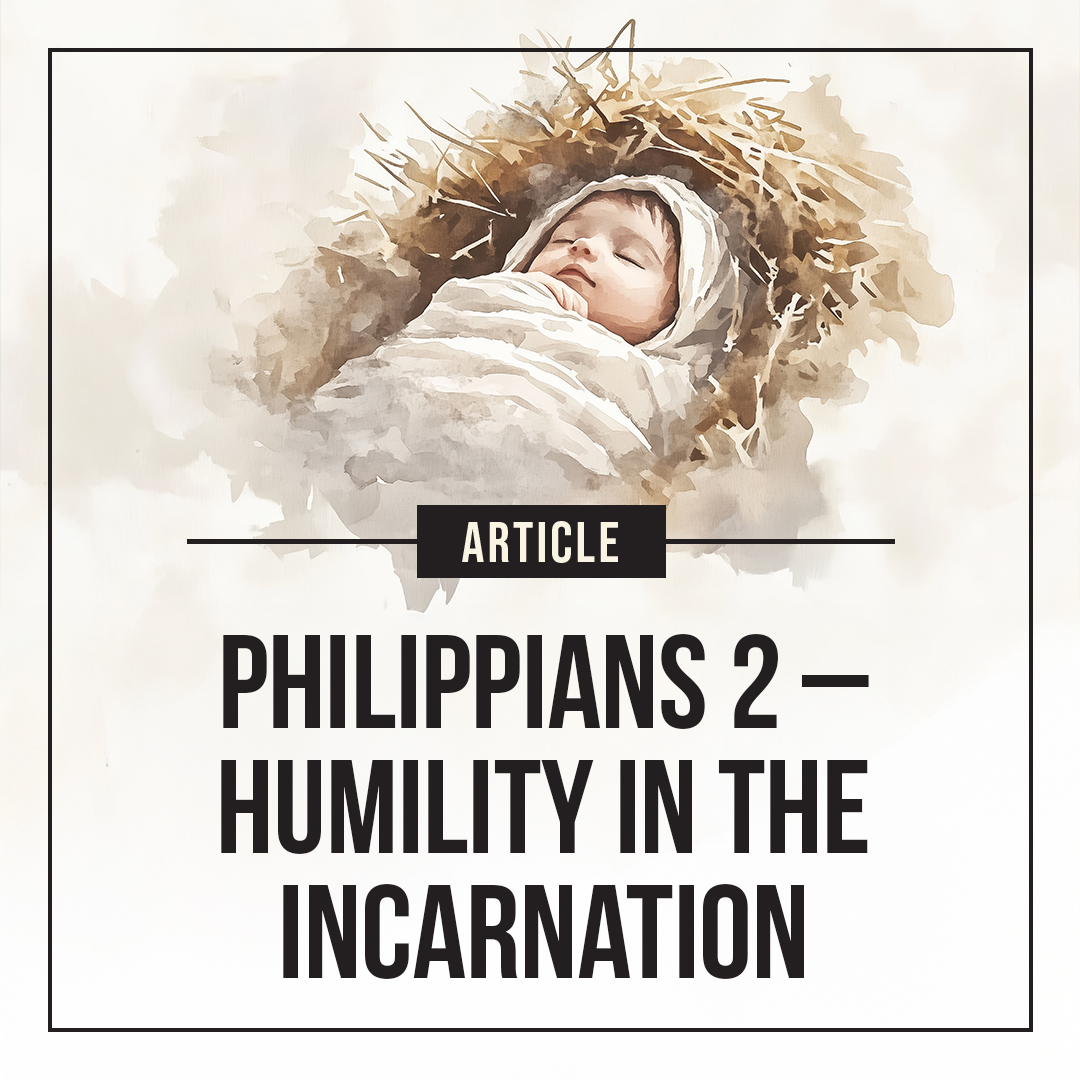
One of the most wonderful Christmas passages comes from Philippians 2:6–8 (ESV). “who, though he was in the form of God, did not count equality with God a thing to be grasped, but emptied himself, by taking the form of a servant, being born in the likeness of men.  And being found in human form, he humbled himself by becoming obedient to the point of death, even death on a cross.”   Let us agree on this point.   We simply cannot appreciate the story of Jesus’ birth until we are clear about His identity.  The stories of Christmas only make sense after we answer the question – who is Jesus?  The NIV uses the phrase the “very nature” of God.  But the ESV and other translations use the word “form”.  The Greek word is “morphe”.  It refers to the true and necessary nature of something, with an emphasis both on the internal and external nature.  Paul is saying that all that can be said of God, that is, of his nature and essence, is true of Jesus.  Jesus is very God of very God.   And yet, at Christmas, we celebrate the babe clothed in human flesh.  The latter part of verse 6 states that in His incarnation, He did not count equality with God a thing to be grasped.  In the Greek, this sentence is difficult to translate.  The word translated as “grasped” was only rarely used in the secular Greek world.  One possible way of interpreting this passage is that Jesus did not lay a hold of His status as God like booty.  It is an image.  Imagine, if you will, a pirate discovering a hidden treasure, buried somewhere on an island.  He has got an old map with an X on it.  The treasure is in a [...]

The Duty of Christmas

By |2025-12-23T14:24:17-08:00Dec 16, 2025|Articles|

It was just over a month ago that I heard a light knock on the front door in the evening. I was slightly startled as it was not a time of day to expect visitors, nor was I waiting with bated breath for the next Amazon package. As I slowly opened the door, my vision was brought low as I was greeted by a small child with an ornate blue box in her hands. I quickly realized she was one of the youngest daughters of the family who had just moved in across the street. Before I could greet her, I was met with an excited smile and a “happy Diwali!” as she offered me the gift in her hands and ran laughing back down the driveway to her dad who was waiting on the curb and waving. As I went back inside I opened my present; it was a modest gift of a handful of almonds and a couple of sweets, but it left me feeling both cared for and convicted. You see, it was not the gift itself that the child was offering me, but an invitation to share in her joy. My question, fellow Christian, is whether or not we will take the opportunity in this Christmas season to invite others into our joy? My concern, as we tend to hear a slew of messages about whether or not we are appreciating “the meaning of the season”, is that in our introspection we distance our minds from those around us. Though it is important for us to have the conviction of the incarnation rekindled in our hearts, how much more so for those in whom the flame has never been lit? It is important to remember that, as a Christian, stewardship is not a role that we [...]

Christmas in God’s Timing

By |2025-12-11T03:58:59-08:00Dec 9, 2025|Articles|

One of my favourite Christmas verses is found Galatians 4:4 (ESV): “But when the fullness of time had come, God sent forth his Son, born of woman, born under the law.” Taken by itself, and left unexamined, one might conclude that the incarnation occurred once God the Father determined it should occur. And of course, that conclusion is not incorrect. God determines all things — even the pathway of every individual molecule — and therefore certainly the sending of his Son into the world. We might go further and say that the historical context into which the Son of God was to be born was also determined by God.  The fact that Israel was under the dominion of the Romans, leaving the nation yearning for a Messiah was not insignificant.  Furthermore, the national belief that they were near the end of the age was everywhere felt.  The corruption in the religious leadership, the poverty among the Galilean people, and many other factors were significant during this time period.  We are all aware of Luke’s description of the baby Jesus being brought to the temple for ritual purification.  Luke 2:25-26 indicates not just the longing of one man, but the longing of the nation.  Luke states, “Now there was a man in Jerusalem, whose name was Simeon, and this man was righteous and devout, waiting for the consolation of Israel, and the Holy Spirit was upon him. And it had been revealed to him by the Holy Spirit that he would not see death before he had seen the Lord’s Christ.” And so, whether it is an aged priest or a longing nation, it is clear that Jesus came at just the right time.  God the Father saw to that. As attractive as it might be to interpret Galatians 4:4 against that [...]

Hope in Discouragement

By |2025-12-11T04:44:57-08:00Dec 2, 2025|Articles|

Discouragement. We’ve all felt it’s power to stall hope, dampen joy, and leave us bewildered. To be discouraged is to lack the courage and resilience to persist within difficulty. We can become discouraged with ourselves, with others, and with life events. Discouragement is tightly linked with unmet expectations. Enter Elijah in 1 Kings – a well-known and respected prophet with a successful history of hearing and obeying God’s voice. The heartbeat of Elijah’s life was for God’s people to return to holiness. The anticipation slowly rose to its climax when God shot a spectacular fireball from heaven to enflame a water-soaked altar, in proof that He was the one true God. Elijah excitedly raced to the city center to get a front row seat of the Israeli leaders renouncing their idolatry and returning to righteousness. But the distressing outcome landed like a poisonous bomb within his heart. Not only did Israel’s leaders refuse to repent, they resolved to assassinate him (1 Kings 19:1-2). With hopes dashed and exhaustion pressing down, Elijah’s discouragement sunk deeper into despair – he wanted to quit ministry and life itself. What was the point of the sensational fiery theatrics if not to produce the outcome Elijah expected? Have you ever felt God’s leading toward a specific end that doesn’t materialize? 1 Kings 18-19 shows how pride, unbiblical thinking, and poor guidance can wrongly fuel discouragement further.   Pride Elijah insisted that he was the only prophet available who could properly secure God’s plan for national restoration (v.10). Because Elijah felt that he was faithful to God, he expected that God be faithful to him by delivering the outcome he’d expected. Yet if the true aim of his life was for God’s glory to be revealed, then even an unexpected outcome would have given him the [...]

The Secret to Being Content

By |2025-11-21T13:39:14-08:00Nov 25, 2025|Articles|

See if any of this feels familiar: before the shine wears off your current phone, a new one comes out and you wonder if you need it. From the end of a long line at the smorgasbord, you look at the smoked salmon and fret that it is going fast. Your 38-inch flat screen TV has been great, but it seems unworkably small as you wander the Costco aisle. Your neighbour parks their new car in their driveway, and suddenly, your car looks like it will break down at any moment. Often, what we have is fine until we see what others have got. We live under a constant deluge of commercials telling us that bigger is better, newer is best and more will make us happy. The ads whisper to a craving already in our heads and hearts – the desire to obtain and possess. Our desires are normal, but sin distorts them. Hunger is normal, but gluttony is a distortion. It is normal to acquire the necessities of living, but greed is an inordinate desire. It lies to us. It promises fulfillment, success and security but delivers an exhausting treadmill that takes us nowhere. Paul commands Timothy to warn everyone who runs after wealth that the chase is a trap. Instead, Timothy is to teach godly contentment with the measure of possessions seemingly low. “If we have food and clothing, with these we will be content” (1 Tim. 6:8, ESV). If we have the essentials, we have enough. Enough to say “Thank you” for. But thanksgiving without contentment is not real gratitude. It nods toward heaven but keeps looking for something better. “If I get the promotion or move into a bigger place, then I will be satisfied.” And the treadmill continues. There is no end to greed. [...]

Staying Locked In

By |2025-11-13T11:31:20-08:00Nov 18, 2025|Articles|

On October 27, 2025, in Game 3 of the World Series, the Blue Jays’ relief pitcher, Brendon Little, did not expect to play. He performed poorly in his last outing, and he was losing the trust of the manager. However, the game went 18 innings (tied for most in World Series history), and he was called up as the last pitcher in the bullpen to pitch in the 17th inning against Shohei Ohtani—one of the greatest players of all time. In this same game, the Dodgers’ Clayton Kershaw, who was in his final season of his career, was called up in the 12th inning to face just one batter. He threw eight pitches. That was it. Athletes often say that they must “stay locked in” even if they are not expected to play because they don’t know when they will be called upon to do their part for the team. Likewise, the Bible calls God’s people to stay locked in. Jesus tells the parable of the ten virgins in which He teaches us to always be prepared: “And while they were going to buy, the bridegroom came, and those who were ready went in with him to the marriage feast, and the door was shut” (Matt. 25:10, ESV). Again, 1 Thessalonians 5:2 says that “the day of the Lord will come like a thief in the night” (unexpected), and that we ought to always stay locked in since we do not know when that day will come: “So then let us not sleep, as others do, but let us keep awake and be sober” (5:6). “Staying locked in,” for Christians, does not mean that we ought to constantly be worried about losing our salvation and live a life trapped in legalism. Rather, in the freedom that God has graciously given [...]

C.S. Lewis, Grief, and the God of All Comfort

By |2025-11-07T14:16:47-08:00Nov 11, 2025|Articles|

“Blessed be the God and Father of our Lord Jesus Christ, the Father of mercies and God of all comfort, who comforts us in all our affliction, so that we may be able to comfort those who are in any affliction, with the comfort with which we ourselves are comforted by God. For as we share abundantly in Christ’s sufferings, so through Christ we share abundantly in comfort too.”  (2 Corinthians 1:3-5, ESV)   Here is a promise!  Our God is called the Father of mercies.  What a marvelous title for our great God.  And as the Father of mercies, He comforts us in our affliction.  In His mercy, He not only calls us to share abundantly in Christ’s sufferings, but also in comfort.  He is able to console those whose burdens are heavy.  This includes consolation for those who are ill, who are suffering loss, who are grieving, who have been persecuted and those who are impoverished.   As wonderful as these promises are, we sometimes forget the other side of this teaching.  It comes from Jesus.  Luke 6:24 records Him as saying, “But woe to you who are rich, for you have received your consolation.”  Now of course, being rich in itself does not bring about the curse.  But failure to use the riches in the way our Lord directed does bring about a curse.  Riches can lead to selfishness, greed, and a neglect of the poor.   And this leads me to reflect on the nature of consolation within the Christian faith.  I was recently meditating on C.S. Lewis’ essay entitled “A Grief Observed”.  It is four short chapters.  He was reflecting on his own grief resulting from the death of his wife, Joy Davidman.  There were a few sentences that arrested my thinking.   Lewis said, [...]

The Love About Truth

By |2025-12-23T13:59:33-08:00Nov 4, 2025|Articles|

I don’t know if I was just oblivious to it prior to these last 5 years of my life as a leader or not, but in my opinion, it’s never been more difficult to give a doctrinal statement on topics of sexual morality and ethics. There’s always some video clip that can be edited without its broader context and presented in such a way that paints someone as a heretic or someone to “mark and avoid”. That’s not to say that there are not statements of bold error and heresy being made on social media (believe me, I’ve heard some doozies), but not every statement of perceived contradiction is one. Sometimes, it’s a complementary “other side of the coin”.   Dangerous Ditches I’ve often said that through modern church history, we have generally fallen into one of two possible ditches: We think we love people more than God and apologize or practically remove any instruction or prohibition His Word gives us that is not wholeheartedly affirmed by the system of this world. Or, we sacrifice love in our declaration of truth, seeing love as some moral and theological weakness, confusing it for affirmation of immoral practices.   What option does that leave us? Before we take a shot at answering that question, I do want to make it clear that I see the current separation of compassion from truth as one of the most dangerous errors the Church is facing right now. Not to say there isn’t an equally dangerous ditch of self-righteous activism and legalism on the other side of the road, but the church is drifting to the side of moral relativism and grace without repentance. Those who remain in either of these extremes will likely never be satisfied by a call to Christ’s balance of grace and [...]

Wholly Surrendered to a Holy God

By |2025-10-27T22:51:49-07:00Oct 28, 2025|Articles|

Holy. It’s the only word in scripture repeatedly echoed three times, demonstrating the supremacy of its value (Rev 4:8-11). Is Jesus’s holiness worth surrendering our lives for?   Joshua prepared to advance into Jericho at the precise location where God’s people disobediently refused to enter 40 years prior (Josh 5-6). The Commander of the Lord, a pre-incarnate Jesus, enters the scene with His sword drawn directly at Joshua. Joshua asks the Commander if he’ll join him in battle, but the Lord asks Joshua if he’ll fully yield to Him. When Joshua recognizes who stands before him, he falls face down surrendered in worship, asking the Lord what is required of his life. It’s a powerful image of full abandon to God’s authority and will, that challenges us today. Do we ask God to join our plans or fully yield to His? Do we fully surrender to His plans even when we don’t understand or agree?   There are many ways that our sinful hearts convince us to resist surrender and believe that partial yielding to the Lord is good enough. Ananias and Saphira pledged one financial amount yet deceptively held back a portion for themselves (Acts 5:1-11). To prevent God’s ark from toppling in the dirt, Uzzah disobeyed God’s command to never touch it (1 Chron 13:10). They justified their spiritual disobedience with human logic which costs them their lives. Our justifications to resist full obedience can stem from the same pride-filled root – we overestimate our goodness and underestimate His holiness. Our attempts to only partially surrender are fully seen by our all-present God who refuses to let us remain at arm’s length. He desires our full surrender so that we fall into His full embrace.   Throughout scripture, we often see people glimpse God’s glory, which simultaneously reveals [...]

What’s Streaming Into Your Soul?

By |2025-10-21T07:33:35-07:00Oct 21, 2025|Articles|

As of 2025, Netflix and Spotify are the most popular streaming services in their respective fields of television/movies and music. Over its 30 years of existence, Netflix has grown to an incredible 301 million paying members, while Spotify has a whopping 696 million active monthly users. Whether it be these or their slew of counterparts (Amazon Prime, Disney+, YouTube, or Apple Music), my strong assumption is that everyone reading this article has some sort of relationship to these services; we live in a world that is completely inundated with entertainment. Whether that variety excites you or locks you into what I like to call “analysis paralysis”, we are faced with the decision of what to do with all of it.   Too often, I believe the stance is taken that what we consume is somehow neutral in its impact on us. The number of times I’ve heard “well Jake, I listen to or watch those things, but they’re not impacting who I am,” or, “I’m simply unwinding after a long day at work.” To that I say, the global spending on digital ads in 2024 was 1.1 trillion dollars. If I know anything, it is that the greed of the corporate world does not throw away over one trillion dollars for nothing. They invest that much because they know it will have an incredible payoff. They know the power of what enters our minds – how it shapes our thoughts, feelings, and desires.   One of the most convicting quotes I’ve heard as of late came from pastor Jonathan Pokluda on his podcast “Becoming Something” as he challenged his listeners to consider if they were “being entertained by the things that Christ died to save [them] from.” I have to admit that hearing that question brought me great pause as [...]

Making the Most of Thanksgiving

By |2025-10-10T02:59:06-07:00Oct 13, 2025|Articles|

I recently asked my Bible Software program how often the phrase, “Give thanks to the Lord” appeared in the Bible.  I was amazed to find that it appeared 21 times.  And of course, that doesn’t take into account phrases like, “Praise the Lord”, or “worship the Lord”.  Some commands to give thanks to the Lord appear as a command for singing.  Psalm 33:2 (ESV) says, “Give thanks to the Lord with the lyre; make melody to him with the harp of ten strings!” Other passages command us to do so in reflection of God’s character.  Psalm 118:1 says, “Oh give thanks to the Lord, for he is good; for his steadfast love endures forever!” Still other occasions include adoration of God along with our requests and the command to declare God’s greatness among the people. The tradition of Thanksgiving is founded on this biblical mandate.  Romans 1 reminds us that failure to thank God is the starting place for spiritual darkness.  And so, Thanksgiving has been a time when local churches often display pumpkins and corn cobs, apples, and bread.  We want to remember that the basics of life come from God’s generous and gracious hand.  He causes the sun to shine on the just and on the unjust.  He has been far more gracious than any of us deserve. It is equally necessary for followers of Christ to make a practice of thanking God for the rich resources that are available to us in our salvation.  But this is often missing from believers.  Yes, it is true that many of us do thank God that we have been saved, but we neglect thanking God for all the various aspects of our salvation.  Even more tragic is the truth that some believers are not aware of all that is provided [...]

4 Benefits of a Good Eschatology

By |2025-10-07T00:41:54-07:00Oct 7, 2025|Articles|

It was not that long ago, when I went out to eat at a restaurant, that I found one of the servers was not there.  Not that unusual.  People need time off.  They might also be suffering from a cold or the flu. It’s always good when restaurant servers are looking out for both themselves as well as their customers.  But alas, none of these reasons related to this case.  In this case, the server in question had believed a theory that the world was going to end on that day.  She had, by the reports I heard, been frightened.  I am not sure, but I pictured her cowering under her blanket at home, awaiting the inevitable. I never heard how the matter turned out.  Did 12:01 in the morning strike, and to her amazement, she went to the window to discover the world was going on as before?  Did she show up the next day and announce she was better now?  As curious as I was about the outcome, I still believe that when people make foolish and embarrassing mistakes, one should afford them some dignity to try and recover.   I write these words because, once again, a false rumour had circulated that the rapture would occur on September 23 or 24 of this year.  If you missed it, you also missed an opportunity to again track the gullible and easily misled.  Furthermore, these kinds of predictions now happen with such frequency, one can hardly blame the average person for having lost interest and not take notice.  “Oh, another prediction of the end of the world?”  That is followed by a yawn.  “What’s new?”   When I was a young man, there was a rather persistent belief among not a few evangelicals, who insisted that Israel’s becoming a [...]

Predicting Christ’s Return

By |2025-12-23T13:58:31-08:00Sep 30, 2025|Articles|

Let’s start with Harold Camping. I know what some of you will say: “Harold who?”  But that is just the point! How soon we all forget. And because we forget, we learn so very little, and are so gullible to the next deception. The late Harold Camping was an American Christian broadcaster. He boldly predicted that the Rapture would happen on May 21, 2011. His ministry spent millions of dollars to spread the word on more than 5,000 billboards, along with 20 RV’s taking this message across the U.S. Some of his followers quit their jobs and sold their possessions as they waited. After May 21 came and went, Camping wrote, “We humbly acknowledge we were wrong about the timing.” You think?  Unfortunately, what was wrong, according to Rev. Camping, is that he was five months off. Furthermore, Camping believed that instead of the rapture, the date had been a day of “spiritual” judgment, which placed the entire world under Christ’s judgment. I wish Harold Camping was the only one to have done such a thing. But sadly, this is not the case. Consider the evidence. In 2 Thessalonians 2:1-2 (ESV), Paul writes, “Now concerning the coming of our Lord Jesus Christ and our being gathered together to him, we ask you, brothers, not to be quickly shaken in mind or alarmed, either by a spirit or a spoken word, or a letter seeming to be from us, to the effect that the day of the Lord has come.” One can only imagine what gave rise to this sentence. Some were proclaiming Christ’s coming had already arrived! Imagine the hype! Imagine the best-selling books that might appear with this theme! In the second century, a heretical group called the Montanists predicted that Christ would return during their lifetime. A great [...]

Does God Care About What We Wear?

By |2025-09-29T13:29:39-07:00Sep 23, 2025|Articles|

In an age of celebrity pastors and social media accounts highlighting what they wear, the question must be asked if God cares about how we dress. Is it necessary, or even possible, to have a Christian ethic when it comes to your wardrobe? Adjacent to my lifelong pursuit of ministry has been a fascination with fashion and how the way in which we dress expresses deeper truths about who we are. Growing up with parents who were officers (pastors) in the Salvation Army, my wardrobe was almost entirely made up of second-hand goods that were well-worn. It was a secret that I held closely as thrifting did not have the positive connotation that it does today; it held a stigma of poverty and desperation. Even at that young age I was aware that, for better or worse, what I wore expressed something about my identity. While I have realized through my life that those unkind judgements did not speak to my value, it remains inevitable that others will make assumptions about my inner values based upon my outer appearance. We live in a watching world, and each aspect of our lives serves as an opportunity to exemplify Christ accurately or wrongly. Believe me, I am aware that we are treading touchy ground here and realize the threat of legalism in creating biblical standards where there are none. My desire in writing this article is not to give you specific rules of how you must or must not dress, but simply to offer a broader ethic of Christian living that seeks to prioritize glorifying God in every aspect of what we do. Are We Faithful Stewards? In James 1:17 we are reminded that every good gift in our lives has ultimately come from God. Every paycheque, good friend or family member, [...]

Finding Eternal Meaning

By |2025-09-26T09:42:46-07:00Sep 16, 2025|Articles|

Everyone looks for something that is lasting. I once carried on a friendship with an atheist. He was on a quest to write a book that would make a major impact, so that he would be remembered after he was gone. It was unacceptable to him that his life would pass away and not one thing of his presence on earth would matter or be remembered. The futility of such an existence was more than he could bear. And in case you are wondering, he never did come up with that book. He failed to reach anything that endured. We want to endure. We can’t fathom the idea that we are simply a passing shadow, or a fad that is quickly gone. Something needs to endure. Quite often, people seek some of that in marriage. They reason that to love someone truly with a love that endures for a lifetime would be meaningful. Of course, even in this, there are many who fail. It ends with the too early death of one partner, or in divorce, or in a disinterested couple who stay together long after the fires of romance and love have left the scene. But even among those who love for 60 years and more, the end is soon at hand, and love does not endure. And this is true about all of life’s endeavours. Whether it is building a business, financial empire, or a building. Something ought to remain when we are gone. Like the pyramids of old, who still stand and give testimony to the builders. I once met a man who had led a research team that successfully created a medication that had saved thousands of lives. It must feel deeply satisfying to have left this earth having brought the betterment of the human race. [...]

The Bible in One Sentence

By |2025-09-26T09:42:46-07:00Sep 9, 2025|Articles|

What is the storyline of the Bible? I want Christians to understand the Bible story from creation all the way to the new creation. We must understand how the story of the Bible develops, and how each subplot fits into the overall drama.   For instance, where do the following accounts fit into the overall storyline: David and Goliath; Daniel in the lion’s den; Isaiah’s prophecy of the suffering servant; or Paul’s injunction of selecting elders and deacons in 1 Timothy 3?   My concern is that we often view the various biblical parts without an understanding of how they fit together into the whole. We can be like the person who opens a box, which contains 3,000 small pieces that, together, make a beautiful picture. But, if we only examine the individual pieces, we will never see the puzzle.   If we are to understand the Bible’s story from beginning to end, in chronological order, it would be valuable to know what the overall picture looks like. It would be like pouring out all those puzzle pieces onto your kitchen table, and then staring at the picture on the front of the box.   Can we do the same with the Bible?   Of course, it is not possible to do that until we have read the story many times. How often have we picked up a contemporary novel, in which the plot of the story is given in the inside flap? In one short paragraph, the reader is made aware of what it is they will be reading.   I have often wondered if just such a paragraph could be given to anyone who begins to read the Bible for the first, or perhaps even for the one hundredth time. Let’s see if we can try to put [...]

Did We Inherit Sin From Adam?

By |2025-09-26T09:42:47-07:00Sep 2, 2025|Articles|

In my upcoming book, I have been discussing the wrath of God revealed from heaven against the unrighteousness of men. Romans 1 and 2 discuss specific deeds of sin, and reflect the reality that all men and women are without excuse. But behind those truths stand the larger truths of inherited sin, or that we are sinners in Adam. Romans 5:12 states that sin came into the world through one man. Sin, therefore, is not inherent to the human race, but is introduced to the human race by one man.  But according to the Bible, our guilt is counted against us in three ways.    1) Firstly, we are counted guilty because of Adam’s sin In Romans 5, Paul compares two men, Adam and Christ. He wants to say there is a similarity between the two men. We are counted guilty in Adam, and we are counted righteous in Christ. Romans 5:19 (ESV) says, “For as by one man’s disobedience the many were made sinners, so by the one man’s obedience the many will be made righteous.” The older English word used to describe this relationship is the word “imputed.” It is an accounting word. Christ’s work has been reckoned, or counted, or imputed to those who are in Christ. In the same way, Adam’s work of sin has been reckoned, or counted, or imputed to all of his descendants. Romans 5:18 adds, “…one trespass led to the condemnation for all men.” This often sounds strange to people. How can I be counted guilty in Adam? The implication is that before I had done anything good or bad, Adam’s sin was reckoned to my debit sheet. It sounds unfair. Imagine the following scenario. You are on a football team playing in the Grey Cup. There are three seconds left on the clock, and you are down by [...]

Who We Are in Christ

By |2025-09-26T09:42:48-07:00Aug 26, 2025|Articles|

This is not an article about sexual identity.  Rather, it is an article about our new identity in Christ.  But I do wish to begin with those who identify as either gay or transgender.  Some time ago, I heard a Christian give a presentation.  He said he was a gay Christian, and because of his faith in Christ, was determined to live a celibate life.   To be clear, I was appreciative of his commitment to be faithful to the gospel until death.  But his presentation started a thought process in my head.  And it had to do with identity.  Truth be told, we all have a sin style.  Another way of stating this is to say that there are temptations that are unique to all of us.  Some of us are prone to not just materialism, but theft.  If that is a temptation you feel, might I suggest you not volunteer to be on the team counting the offering each Sunday in your local church.  If you struggle with lust, might I suggest you find an accountability partnership in your viewing habits.  If you struggle with anger, might I suggest you practice patience and thankfulness in all things.  If you struggle with gossip, discipline yourself to speak words of blessing.  Each of us struggles with some sins more than others.  And on that note, some struggle with same sex-attraction, whereas some never do.   But might I suggest that we don’t identify with our sins.  We should not say, I am a Christian luster, or a Christian thief, or a Christian pugilist who has chosen not to practice.  Rather than identify with the sins of the flesh, scripture calls us to identify with the new nature.  Consider what Peter says of us: “But you are a chosen race, a [...]

How to Deal With Shame

By |2025-09-26T09:42:48-07:00Aug 19, 2025|Articles|

What drives us to isolation? Across my time in pastoral ministry, I have witnessed many believers struggle with the temptation to distance themselves from both God and people amidst times of trial. It is a curious response, isn’t it? When one is in their lowest moment to separate themself from support. It is an odd behaviour, but far from new. The human tendency to isolate can be seen since the beginning of creation. Adam and Eve “hid” from God in the Garden following their primordial wandering: “And they heard the sound of the LORD God walking in the garden in the cool of the day, and the man and his wife hid themselves from the presence of the LORD God among the trees of the garden” (Genesis 3:8, ESV).   What was it that caused them to hide? We see just a couple of verses later that they were afraid; afraid that God would see them in their nakedness. They were vulnerable and worried about what would happen when God “discovered” their sin. You see, it was not simply fear that caused them to hide, but a fear that grew out of shame.   The Oxford English Dictionary defines shame as such, “a painful feeling of humiliation or distress caused by the consciousness of wrong or foolish behaviour.” Shame is born out of the decisions we make and look back upon wishing we had made another choice. Maybe it was an unthoughtful word, a dishonest business deal, or the fall back into pornography after you had promised yourself that last time was the last time. Shame floods into our hearts and minds.   I clearly remember a young adult man I had a conversation with after not seeing him at church for at least a month. As we sat down [...]

Do Old Testament Laws Still Apply?

By |2025-09-26T09:42:49-07:00Aug 12, 2025|Articles|

From passages such as the ones quoted, a great many Christians have thought that the law of Moses is no longer valid for us today. But what does that mean? Do we no longer have to keep the 10 commandments?

Jesus’ Final Command

By |2025-09-26T09:42:49-07:00Aug 5, 2025|Articles|

The call to make disciples of people from every people group on earth was Jesus’ last command to his disciples.  Consequently, Christians have often commented that Jesus’ last command should be among our first priorities. In one sense, the task has been a smashing success.  If we ask the pollsters, there are between two billion to two and a half billion Christians in the world.  Furthermore, as many are telling us, Christianity has, in the last half century, grown to a considerable degree in the global south and in nations that have been highly resistant to the gospel.  If we take these accounts at face value, Christ’s commands have been kept. But we need to remember that the problem with these statements is that they have a poor definition of what it means to be a Christian and how many adherents there actually are.  A few years back, I discovered a website featuring the most Christian countries in the world, and to my surprise, found that they had listed Canada as 67% Christian.  Our neighbours to the South were listed at 71% Christian.  Because I know something of the miserable state of the Christian faith in Germany, I was surprised again when they listed 56% of Germans to be Christian.  My sense is that that might be news to some of the Germans who are listed as Christians. Then again, on the other hand, I was just as surprised to read that they had listed Iran as having less than half a percent of Christians.  And China, which has seen such a massive uptick in the underground church, gave little indication of having any at all! All that to say, the figures are wrong!  But what if we were to change the equation.  What if we asked how many nations [...]

God: Accountable to No One

By |2025-09-26T09:42:50-07:00Jul 29, 2025|Articles|

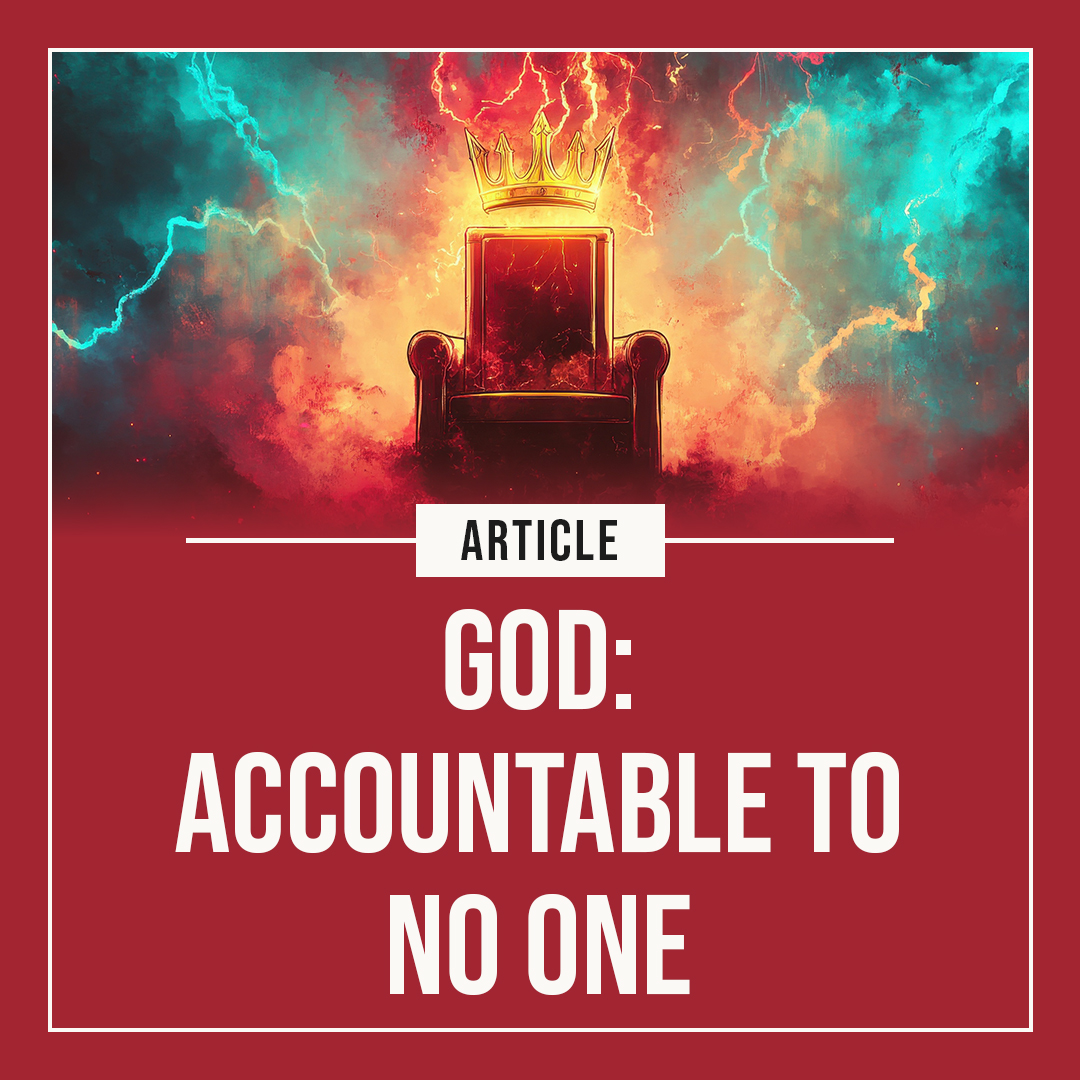
“Truly, you are a God who hides himself, O God of Israel, the Savior” (Isaiah 45:15, ESV)   The Power of “Gotcha” Politics has descended into a “blame game.” In place of compromise and co-operation, political leaders use accusations and allegations to build a following and hold on to power. Politics has never been free of such things, but neither have impeachments, denunciations and squabbles formed the primary civic means. It's appropriate to hold power to account. We expect explanation and justification for words and actions. Policy positions should be defended. Judgements need a foundation. Errors or misdeeds deserve exposure. We expect that in politics, business, the courts and education, the public has a right to know what goes on behind the curtains. So, it seems strange to some that the supreme power of the universe is accountable to no one.   Without Explanations In Isaiah 45, God says that he will raise up a pagan ruler named Cyrus and employ him to restore Israel to Jerusalem from Babylonian captivity. God calls Cyrus despite his brutality and immorality. Cyrus does not know Jehovah and is blind to God’s intent. If someone questions the means of God, He declares, “I form light and create darkness; I make well-being and create calamity; I am the Lord, who does all these things” (Isaiah 45:7). With a bluntness that is unusual for power, God declares that He alone is the Lord and is not accountable to any. The clay bowl doesn’t question the potter. The child cannot fathom the ways and means of the father. God simply declares what He is doing and doesn’t respond to the microphones thrust at Him for explanations. Perhaps that is why Isaiah asserts that God hides Himself. The prophet doesn’t mean that God is coy, but he admits [...]

3 Ways Christians Can Fight Anxiety

By |2025-12-23T13:57:19-08:00Jul 22, 2025|Articles|

It was just over a year ago that I had my first foray with anxiety. This was not a slow and steady introduction, more like waking up in the midst of being pushed out of a plane to parachute behind enemy lines. In the span of one night, it felt as though my mind had gone from a safe haven where I could parse out my feelings to a chaotic and unpredictable environment. Not only had my mind betrayed me, but so had my body. My heart constantly raced, blood-pressure skyrocketed, and my stomach was flooded with nausea. I remember one night sitting in the waiting room at the local ER, heart pounding so hard that my vision blurred, thinking with certainty that I was about to die. That was my first panic attack. In a Western world that is so focused on the prevalence of mental health, it is shocking how unprepared you can still feel when it creeps up in your own life. Anxiety often feels like an uncontrollable storm that has blown in without warning. It is the reality of living in a fallen world that has not only impacted us spiritually, but also mentally and physically. Thankfully, our gospel hope extends to all of those categories.   Proactive protection As instantaneous as anxiety can feel, it is rarely the case that it has spontaneously arisen. Typically, there are patterns or events in our lives that, when accumulated, create the proverbial straw that breaks the camel’s back. The aim is not to predict or address that singular moment where everything comes crashing down, but to prevent mental stockpiling from occurring in the first place. Every day we face a multitude of potential stressors: traffic jams, an upset boss or bad shift, and that unexpected bill in the [...]

Carbonated Holiness: Laughter Is Serious Business

By |2025-09-26T09:42:51-07:00Jul 15, 2025|Articles|

Several years ago, I threw out three boxes worth of my kids’ Sunday school crafts. I felt heartless and vaguely evil. But really, one can only store so much Fun Foam in a single house.   Still, there was one piece of art I was compelled to save. My daughter had cut out and coloured pictures of children engaged in different acts of worship, and glued them onto a sheet. (She was three; you were expecting decoupage?)   Bethany had been particularly proud of this assignment because of the gluing part. (I think she may have a future in adhesives.) The day she brought it home, I acknowledged the excellence of the glue-work and then asked her to tell me what the pictures represented. “Praying! Giving! Reading the Bible!” she shouted as I pointed to each scene.   I saved the best picture for last—a boy with his mouth open wide in song. Singing is my favourite form of worship. I knew it would be Bethany’s too, what with her mother being a singer and all.   “Laughing,” said Bethany, when I pointed to the boy with the open mouth.   I stood corrected. Laughing is my favourite form of worship.   I’ve been backing up my laughter-as-worship theory for a while now, collecting various quotes on the matter. I was compelled to stop reading Anne Lamott’s Plan B long enough to shout “Yes!” (complete with fist-pump), and scribble this line on an airplane napkin: “Laughter is carbonated holiness.” And anyone who knows me will understand why I give a hearty amen to this bit of wisdom from Woody Allen: “I am thankful for laughter, except when milk comes out of my nose.” (In my case, there was an unfortunate incident involving Diet Coke, and the memory of it gives [...]

Reaching Canada for Christ

By |2025-12-09T02:01:17-08:00Jul 1, 2025|Articles|

In the book of Ezekiel, chapter 37 talks about the “dry bones.” Led by the Holy Spirit to a valley full of human bones, the prophet asks, “Son of man, can these bones live?” (Ezek. 37:3, ESV). Of course, this vision represents the house of Israel, as the northern kingdom has been taken into captivity, and the Babylonian army stands ready to destroy the southern kingdom as well. The question, “Can these bones live?” is therefore a question about the ultimate future of the nation. Closer to home, we must ask a similar question regarding the state of Christianity in Canada. But first, let’s survey the landscape. In his book, What Happened to Christian Canada?, American church historian Mark Noll recounts that a dramatic “de-Christianisation” among both French Catholics and English Protestants began during the 1960s. Most of us are well aware of this. In the mid 1980s, some 43% of Canadians attended a religious service in Canada, but today, that number stands around 25% and is still declining. Furthermore, there has been a dramatic growth of those who claim no religious affiliation (now at 25%). Today, over 10% of Canadians belong to a religion other than Christianity. In short, the spiritual landscape is profoundly different than we have ever seen. Yet there is an added complexity to the situation, because not all Christian churches in Canada are in decline. Due to immigration, the number of Catholics in Canada is increasing. While only about 12% of Canadians are evangelical, that number has not been dropping. The great decline has really occurred among mainline Protestant groups such as the United Church of Canada and the Anglican Church. Interestingly enough, these denominations were most likely to deny biblical authority and adopt a more secular expression of faith. Or to put it another way, the denominations [...]

No Shame in Grace

By |2025-09-26T09:42:52-07:00Jun 23, 2025|Articles|

There is a difference between guilt and shame. Failing to recognize the distinction leads to confusion, or even despair. The distinction between guilt and shame is valid within our courts, relationships and souls. So, the matter is important in many aspects of living; family, friendships, church, and most of all, in our walk with God.   Guilt is a legal concept. It is a declaration of an offence against law, morality or persons. It is not ambiguous - either we did the crime or did not. We may offer excuses before a judge for speeding, try to explain our playground actions in the principal’s office, or complain in prayer that we had no other option, but there is no grey in guilt. The Bible declares that before God, we all are guilty. Each one of us has transgressed, and we have no means to erase it. Our only hope is the life and death of Jesus. Guilt cannot be removed, but it can be atoned, forgiven and forgotten. Through faith, anyone can have their guilt reversed forever. This is an act of grace for us.   Shame is not a legal concept. It is not a declaration, but a feeling. Shame is our emotional reaction when our guilt is known by others. We may sense judgement or condemnation from them, and we absorb their disappointment. Shame is the stigma of our failures. Shame is rooted in guilt, but it is not automatic. Some are guilty but do not sense scandal. They flaunt their crimes and have no sense of shame. Their ability to blush is broken. But that is not you. If I am not mistaken, many reading this do not dismiss their shame, in fact they wrestle with it.   We see our guilt and feel regret morphing into [...]

Words Matter

By |2025-09-26T09:42:53-07:00Jun 18, 2025|Articles|

I could not number the conversations I’ve had in which the phrase “that is just semantics” has been uttered. Typically, what the phrase suggests is that both parties are making the same point but with different words. On a recent road trip, I was eager to get to the “destination” while the driver couldn’t wait to arrive at the “final stop.” By the end of the day, we had ridden in the car far too long, and the 'Long Drives and Good Times' playlist had lost its charm by the twelfth playthrough, and I had just eaten the last sour cream and onion Pringle. While it might be true that the particular words we choose to describe a road trip have little consequence, too often we show little care for our vocabulary across the board.   For a number of years, I worked at a para-church ministry that served as a shelter and resource centre for vulnerable youth. I was involved in several meetings with other service providers in which we discussed the topic of homelessness. It was always interesting to me that there seemed to be a new term to classify those living on the street at almost every meeting: homeless, houseless, unhoused, unsheltered, person experiencing houselessness. It’s important that we speak of people with respect and dignity. The words being used painted homelessness with gloomy language. Our words shaped our perspective.   At first glance, this might not seem like an issue, but on closer inspection it can become quite problematic. I assume that you do not look fondly upon the problems of your life. They are nuisances, unwelcome situations that frustrate and make daily life more difficult. They are to be overcome. Without intending to sound harsh, the people in those meetings were using language which portrayed [...]

Before You Wake, God Works

By |2025-09-26T09:42:54-07:00Jun 10, 2025|Articles|

“There was evening and there was morning, the first day.” (Genesis 1:5, ESV)   Taking Care of Business When did you start your day? For some, the alarm jarred you early, say 5:30 or 6:00 am. Others had kids or pets wake them at 7:00. Whatever hour your eyes first open, it is common for us to think that our day starts with the morning sun. Our day of work or leisure begins with the daylight and ends in the darkness, for some well past sunset. So, it is common that the day begins with a rush. We make sure everyone is dressed and fed to head out the door. We drop off family members while our minds race to conquer the “to-do” list of today and catch up on what was left over from yesterday. For many, mornings tend to be chaotic, but the biblical model is different.   Begin in the Dark The Genesis account measures a day differently. Repeatedly we are told that the span of a day begins with evening and morphs into morning. That’s why the Sabbath begins and ends with sunset, not sunrise. The Genesis day begins with the dark. So, what difference does it make if we measure a day from sunrise to sunset, from midnight to midnight or from sunset to sunset? I am not suggesting that we revolutionize our calendars or clocks; but the Genesis format does transform our understanding of work and control of our time.   The Genesis day starts with the evening, generally a time when we begin to relax. We have put away many of our duties, gathered in our homes and start to doze off. Written before artificial light, the Genesis day begins with dusk, dimming light moving into darkness. This day commences not with a [...]

Go to Top