3.2 min read
April 2, 2026
Isaiah 53 and Easter: The Substitute Saviour
Isaiah 53
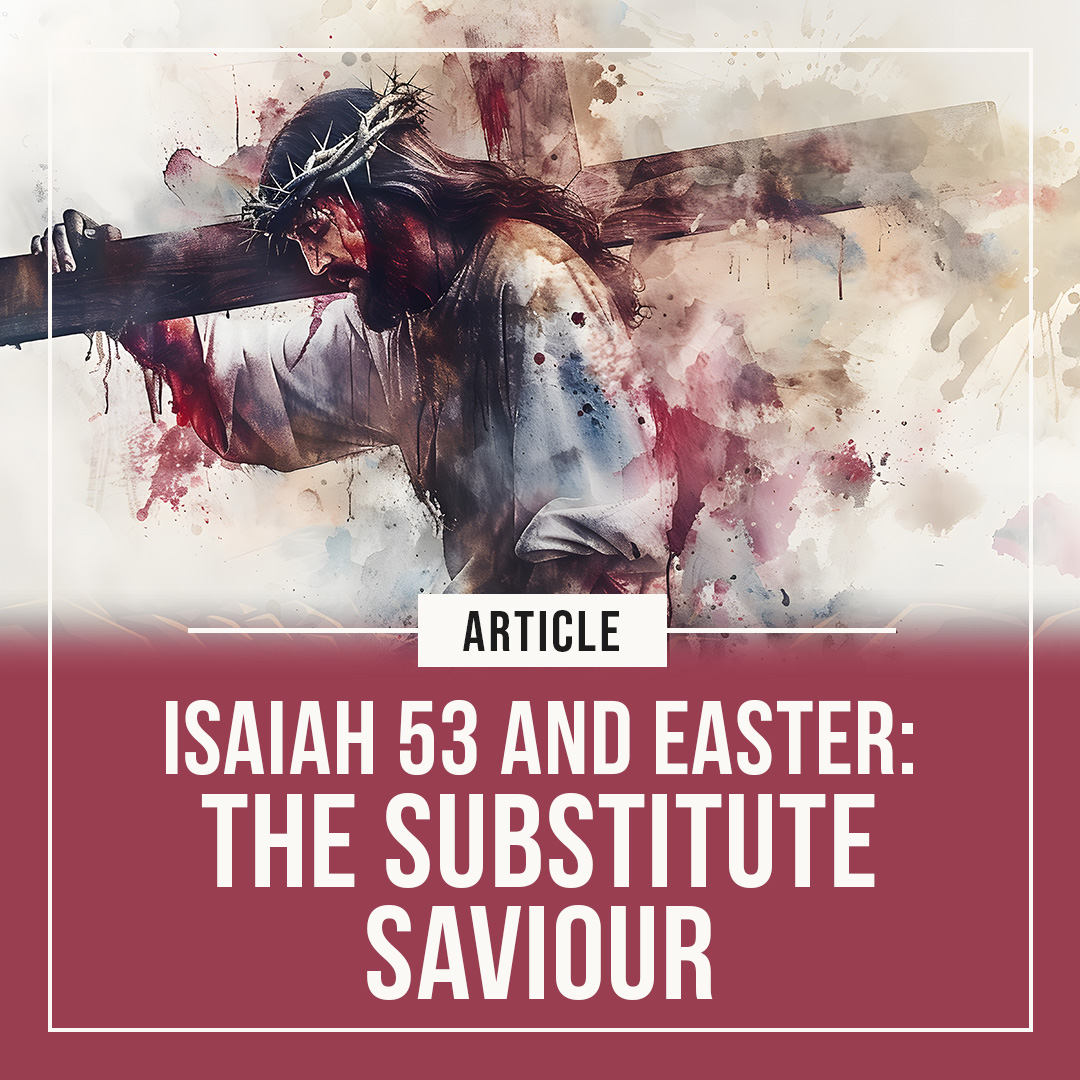
Hour after dreaded hour went on, and Jesus continued to hang on the cross, suffering in a way no human being can imagine. The horrors of crucifixion have been well documented by others. The Romans had developed a method of capital punishment not dreamed of by others. And so, Jesus suffered intense physical pain. Furthermore, men gathered around Him and mocked Him. The Son of God mocked by wicked men. But there was more. Indeed, His greatest suffering was neither the physical pain nor the psychological mocking from His enemies.
Isaiah, over 700 years before the crucifixion of the Messiah, helped us understand what this event would entail. In chapter 53:4 (ESV), He was “smitten by God,” says Isaiah. In verse 6 of the same chapter, Isaiah says “the LORD has laid on him the iniquity of us all.” Read with great care the words of Isaiah 53:10 and tremble. “Yet it was the will of the LORD to crush him.” It’s hard to take these words in. But we must face what the prophet tells us. “It was the will of the one true living God to crush His eternal and beloved son on the cross.” God had willed it. He was crushing His Son on the cross.
And as hour after horrifying hour dragged on with Jesus, our sin substitute, hanging on the cross, suffering for the sins of the world, He cried out, “How long? Why have you forsaken me?”
And yet while we might well recoil from such horror, one salient truth must not be forgotten. While He hung bleeding, dying and being crushed by the Father, Jesus never ceased to be the object of the Father’s delight. Isaiah said of Jesus “the will of the LORD shall prosper in his hand.” Here hung the Son, displaying the righteousness of God in a way the human race had never seen before. God’s righteousness is displayed in a way that the law never could.
On the cross, God both displayed His displeasure with sin and His love of the human race. And so, even while the Father poured out His wrath on the Son, He held the Son as His highest joy. For the Son went to the cross to glorify the Father. And in turn, the Father glorified the Son.
No, this is not child abuse, as the unbelieving critics love to say. Rather, this was a display, both of the holiness and the love of God. This alone is the only place in all creation where both holiness and love meet. Hence the cross of Jesus is the most precious and holy place on earth.
In our day, the disagreement over the penal substitutionary atonement of Jesus, which Isaiah spoke of, is not a minor matter. If we engage in heated debate on this matter, it is worth the controversy. There is no middle ground here. I would argue that the greater the divide between the two sides, the better. For if the Son of God was not punished on our behalf, then the Father’s justice was not satisfied and we are not forgiven. All that remains is for us to pay for our own sins.
But Isaiah, although he lived over 700 years before the cross, saw the matter with amazing clarity. Read carefully as he explains, and let his words settle our doubts about the meaning of this event. “Surely he has borne our griefs and carried our sorrows; yet we esteemed him stricken, smitten by God, and afflicted. But he was pierced for our transgressions; he was crushed for our iniquities; upon him was the chastisement that brought us peace, and with his wounds we are healed. All we like sheep have gone astray; we have turned—every one—to his own way; and the Lord has laid on him the iniquity of us all.” (Isaiah 53:4-6)

Written by : Dr. John Neufeld
Dr. John Neufeld is the national Bible teacher at Back to the Bible Canada. He has served as Senior Pastor, church planter, conference speaker and educator, and is known both nationally and internationally for his passion and excellence in expositional preaching and teaching.