4.6 min read
September 1, 2026
Transformed or Just Forgiven?
Genesis 25–36
Years ago, a very popular bumper sticker on Christians’ cars read, “Christians aren’t perfect, just forgiven.” I hated those things. Probably because all the people who had them ended up cutting me off in traffic, and I felt they were saying, “Oh well! I’m not perfect, but God will never hold me responsible for running you off the road!” Somehow, I wasn’t very impressed by that kind of forgiveness!
Seriously, I agree that Christians aren’t perfect — I know that all too well in my own life. And I agree that we are forgiven — that is a truth that still fills me with amazement and wonder! Grace has been the theme of my life.
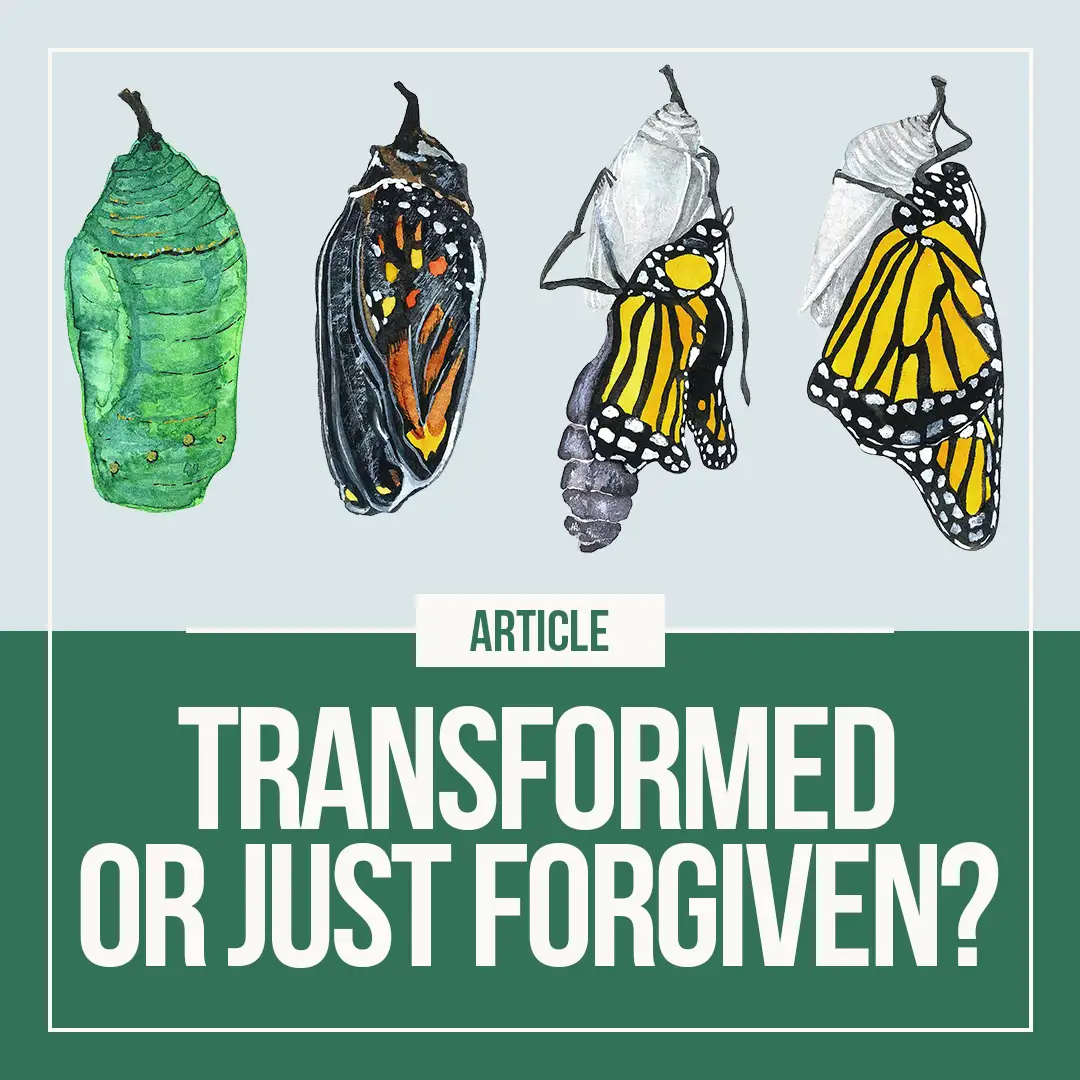
But I didn’t like one word of that bumper sticker: “just”. You see, if Christians were “just forgiven” and that’s all, it would mean we can rule out any substantial transformation in the life of an individual. What attracts the world to us is not that we are forgiven, but that we are changed.
Conversion always involves transformation and life-altering change! But, as many of us know, some Christians seem less transformed than others. Now, if you are one of those Christians who are less than transformed in your driving habits, may I suggest something? Don’t get any bumper stickers!
I’ve been doing a sermon series on Jacob from Genesis 25–36, and up until chapter 33, it’s all been about grace. Jacob has been a grasping, deceitful man whom God had chosen as a vessel of mercy. It’s about our unworthiness and God’s kindness.
But in Genesis 32, Jacob encounters (and wrestles with) God, and by chapter 33, the life of God has begun inside of him, and we can view him as a man who has been transformed by grace.
Jacob is anything but perfect, but he is transformed, and we can learn from him! Read Genesis 33 to see 6 areas of his life where we see that transformation:
- Sacrifice (vv.1–3)
Thinking that Esau is coming for vengeance, Jacob lines his family behind him and walks ahead, so that perhaps Esau will be satisfied in simply killing him, leaving Jacob’s family alive. Every believer in Christ is freed from the enslavement of loving ourselves first. Christianity does not make selfishness a virtue, but selflessness.
- Humility (vv.3–8)
In verse 3, we are told that Jacob goes forward, bowing 7 times, until he actually reaches his brother. In verse 5, Jacob calls himself “your servant,” and in verses 8, 12, and 14 he calls Esau “my lord.” Instead of struggling to get the superior status over Esau as Jacob did in the past, now the pride is stripped away and there is humility in its place.
- Glorifying God (v.5)
Esau asks Jacob whose large family this is and what of all this obvious wealth. He could have said, “I made it big, man! I hit the jackpot!” But instead, we notice that he is prepared to give God the credit. He says, “this is what God graciously gave me. It was His grace; I deserve none of this.” That is a transformed character!
- Reconciliation (vv.8–11)
Back when Jacob was still afraid that Esau meant him harm, he had sent him a large gift to try to pacify him. It would have set Jacob back financially. Now Esau is not angry and doesn’t want this gift, but Jacob refuses to take it back. Jacob won’t let this go until he has paid back his wrongs.
Reconciliation, if it is in our hands to do it, really does matter. Sometimes it is costly. Sometimes it demands humility. Sometimes it means we have to confess our indebtedness to someone and pay the debts we owe, whether they are financial or something else.
- Wisdom (vv.12–17)
Jacob can’t go live in Seir with Esau because he has never lost a sense of God’s destiny in his life: the Promised Land of Abraham, Isaac, and now Jacob.I call that wisdom that is part of the new creation. All believers have a sense of a sacred land, a calling, a place where we belong. Ultimately, that land is heaven! Along the way, there will be those who, even out of good intentions, would keep us from there. Now prizing wisdom, we finally understand that nothing can keep us from where God is leading us.
- Worship (vv.18–20)
Finally, we see that Jacob has a priority for worship. Jacob goes to Shechem and builds an altar there. Jacob was going to the very place where the adventure began with Abraham to stake his claim in God and he builds an altar to worship God. He calls it El-Elohe-Israel: God, the God of Israel (Jacob’s new name). He needs to worship, to express that his soul has found delight in God.
That’s the new Jacob. What he has become represents what we become when Christ is found in us. We’re not just forgiven, we’re transformed.
If I were to redo that bumper sticker (“Christians aren’t perfect, just forgiven”) I think it would read something like this: “Forgiven Christians aren’t perfect, but we long to be.” And the only place where perfection is found is to sit, or stand, or kneel in the presence of our God, and to find delight in Him. Like Jacob, we are being transformed — we’re not perfect, but we long to be!
Listen to Dr. John’s full teaching on Genesis 33: Marks of the New Creation

Written by : Dr. John Neufeld
Dr. John Neufeld is the national Bible teacher at Back to the Bible Canada. He has served as Senior Pastor, church planter, conference speaker and educator, and is known both nationally and internationally for his passion and excellence in expositional preaching and teaching.